Readings Newsletter
Become a Readings Member to make your shopping experience even easier.
Sign in or sign up for free!
You’re not far away from qualifying for FREE standard shipping within Australia
You’ve qualified for FREE standard shipping within Australia
The cart is loading…


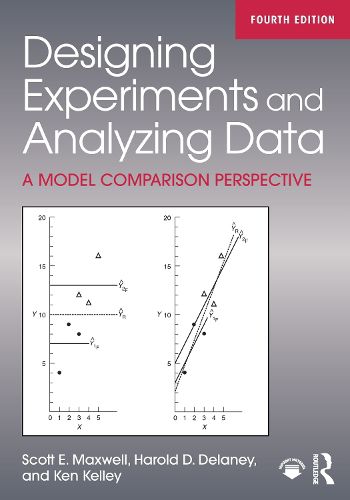
Designing Experiments and Analyzing Data: A Model Comparison Perspective (Fourth edition) offers an updated version of the award-winning text that has influenced the social sciences for more than a generation.Maxwell, Delaney, and Kelley first apply fundamental principles to simple experimental designs followed by an application of the same principles to more complicated designs. Their integrative conceptual framework better prepares readers to understand the logic behind a general strategy of data analysis that is appropriate for a wide variety of designs, which allows for the introduction of more complex topics that are generally omitted from other books. Numerous pedagogical features further facilitate understanding: examples of published research demonstrate the applicability of each chapter's content; flowcharts assist in choosing the most appropriate procedure; end-of-chapter lists of important formulas highlight key ideas and assist readers in locating the initial presentation of equations; useful programming code and tips are provided throughout the book and in associated resources available at DesigningExperiments.Com; and extensive exercises help develop a deeper understanding of the topics. Detailed solutions for some of the exercises and realistic data sets are included on their website, DesigningExperiments.Com. The pedagogical approach used throughout the book enables readers to gain an overview of experimental design, from conceptualization of the research question to analysis of the data. The book and its companion website with web apps, tutorials, and detailed code are ideal for students and researchers seeking the optimal way to design their studies and analyze the resulting data.
$9.00 standard shipping within Australia
FREE standard shipping within Australia for orders over $100.00
Express & International shipping calculated at checkout
Stock availability can be subject to change without notice. We recommend calling the shop or contacting our online team to check availability of low stock items. Please see our Shopping Online page for more details.
Designing Experiments and Analyzing Data: A Model Comparison Perspective (Fourth edition) offers an updated version of the award-winning text that has influenced the social sciences for more than a generation.Maxwell, Delaney, and Kelley first apply fundamental principles to simple experimental designs followed by an application of the same principles to more complicated designs. Their integrative conceptual framework better prepares readers to understand the logic behind a general strategy of data analysis that is appropriate for a wide variety of designs, which allows for the introduction of more complex topics that are generally omitted from other books. Numerous pedagogical features further facilitate understanding: examples of published research demonstrate the applicability of each chapter's content; flowcharts assist in choosing the most appropriate procedure; end-of-chapter lists of important formulas highlight key ideas and assist readers in locating the initial presentation of equations; useful programming code and tips are provided throughout the book and in associated resources available at DesigningExperiments.Com; and extensive exercises help develop a deeper understanding of the topics. Detailed solutions for some of the exercises and realistic data sets are included on their website, DesigningExperiments.Com. The pedagogical approach used throughout the book enables readers to gain an overview of experimental design, from conceptualization of the research question to analysis of the data. The book and its companion website with web apps, tutorials, and detailed code are ideal for students and researchers seeking the optimal way to design their studies and analyze the resulting data.
Search our extensive online catalogue.
