Readings Newsletter
Become a Readings Member to make your shopping experience even easier.
Sign in or sign up for free!
You’re not far away from qualifying for FREE standard shipping within Australia
You’ve qualified for FREE standard shipping within Australia
The cart is loading…


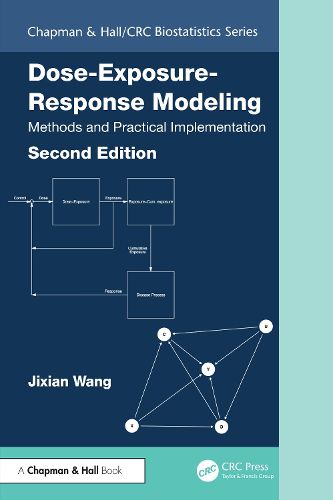
This thoroughly revised and updated new edition reflects the progress that has been made in dose-exposure-response (DER) modeling. As the title suggests, the new edition covers more topics on dose and dose adjustment. A large part of the book has been rewritten, including an updated Bayesian analysis and modeling chapter with new materials on ap-proximate Bayesian modeling with misspecified models, Bayesian bootstrap for the "cut-the-feedback" approach, and meta-regression with Stan codes for implementation. Two new chapters in this edition include one on causal DER modeling, with an introduction to the concept of causal DER relationship, approaches such as the generalized propensity score and instrumental/control function approaches for adjustment for observed and un-observed confounders, and Bayesian causal DER modeling. Another new chapter is dedicated to learning DER relationships with the concept and methods of machine learning, including applications to adaptive dose finding trials by bandits, contextual bandits, and Thompson sampling with Bayesian bootstrap, adaptive control for tracking using a dynamic model with an application for individual warfarin dosing. The new appendix contains non-standard materials used in the book.
Applied statisticians and modelers can find details on how to implement new approaches, while researchers can find topics for or applications of their work. In addition, students can see how complicated methodology and models are applied to practical situations.
Key Features:
Provides SAS, R, and Stan codes that will enable readers to test the approaches in their own scenarios.
Gives a systematic treatment of concepts and methodology.
Helps with understanding concepts and evaluating the performance of new methods, particularly those in Chapters 7, 8, and 9.
Includes a large amount of R codes for methods introduced in the new materials in chapters on Bayesian analyses, causal inference, and dose-adjustment.
Includes a simulation to show how some complex methods such as generalized propensity score adjustment and adaptive dose adjustment can be implemented with simple codes.
$9.00 standard shipping within Australia
FREE standard shipping within Australia for orders over $100.00
Express & International shipping calculated at checkout
Stock availability can be subject to change without notice. We recommend calling the shop or contacting our online team to check availability of low stock items. Please see our Shopping Online page for more details.
This thoroughly revised and updated new edition reflects the progress that has been made in dose-exposure-response (DER) modeling. As the title suggests, the new edition covers more topics on dose and dose adjustment. A large part of the book has been rewritten, including an updated Bayesian analysis and modeling chapter with new materials on ap-proximate Bayesian modeling with misspecified models, Bayesian bootstrap for the "cut-the-feedback" approach, and meta-regression with Stan codes for implementation. Two new chapters in this edition include one on causal DER modeling, with an introduction to the concept of causal DER relationship, approaches such as the generalized propensity score and instrumental/control function approaches for adjustment for observed and un-observed confounders, and Bayesian causal DER modeling. Another new chapter is dedicated to learning DER relationships with the concept and methods of machine learning, including applications to adaptive dose finding trials by bandits, contextual bandits, and Thompson sampling with Bayesian bootstrap, adaptive control for tracking using a dynamic model with an application for individual warfarin dosing. The new appendix contains non-standard materials used in the book.
Applied statisticians and modelers can find details on how to implement new approaches, while researchers can find topics for or applications of their work. In addition, students can see how complicated methodology and models are applied to practical situations.
Key Features:
Provides SAS, R, and Stan codes that will enable readers to test the approaches in their own scenarios.
Gives a systematic treatment of concepts and methodology.
Helps with understanding concepts and evaluating the performance of new methods, particularly those in Chapters 7, 8, and 9.
Includes a large amount of R codes for methods introduced in the new materials in chapters on Bayesian analyses, causal inference, and dose-adjustment.
Includes a simulation to show how some complex methods such as generalized propensity score adjustment and adaptive dose adjustment can be implemented with simple codes.
Search our extensive online catalogue.
