Readings Newsletter
Become a Readings Member to make your shopping experience even easier.
Sign in or sign up for free!
You’re not far away from qualifying for FREE standard shipping within Australia
You’ve qualified for FREE standard shipping within Australia
The cart is loading…


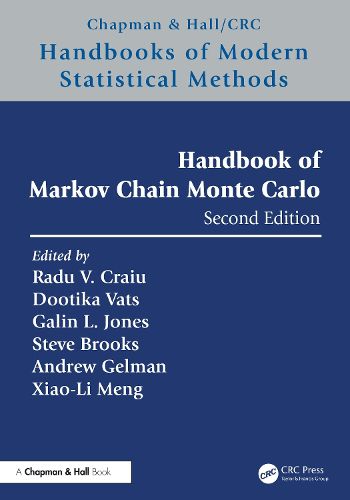
This thoroughly revised and expanded second edition of the Handbook of Markov Chain Monte Carlo reflects the dramatic evolution of MCMC methods since the publication of the first edition. With the addition of two new editors, Radu V. Craiu and Dootika Vats, this comprehensive reference now offers deeper insights into the theoretical foundations and cutting-edge developments that are reshaping the field.
Features:
Completely restructured content with 13 updated chapters from the first edition and 10 entirely new chapters reflecting the latest methodological advances In-depth coverage of recent breakthroughs in multi-modal sampling, intractable likelihood problems, and involutive MCMC theory Comprehensive exploration of unbiased MCMC methods, control variates, and rigorous convergence bounds Practical guidance on implementing MCMC algorithms on modern hardware and software platforms Cutting-edge material on the integration of MCMC with deep learning and other machine learning approaches Authoritative treatment of theoretical foundations alongside practical implementation strategies
This essential reference serves statisticians, computer scientists, physicists, data scientists, and researchers across disciplines who employ computational methods for Bayesian inference and stochastic simulation. Graduate students will find it an invaluable learning resource, while experienced practitioners will appreciate its balance of theoretical depth and practical implementation advice. Whether used as a comprehensive guide to current MCMC methodology or as a reference for specific advanced techniques, this handbook provides the definitive resource for anyone working at the intersection of Bayesian computation and modern statistical modeling.
$9.00 standard shipping within Australia
FREE standard shipping within Australia for orders over $100.00
Express & International shipping calculated at checkout
Stock availability can be subject to change without notice. We recommend calling the shop or contacting our online team to check availability of low stock items. Please see our Shopping Online page for more details.
This thoroughly revised and expanded second edition of the Handbook of Markov Chain Monte Carlo reflects the dramatic evolution of MCMC methods since the publication of the first edition. With the addition of two new editors, Radu V. Craiu and Dootika Vats, this comprehensive reference now offers deeper insights into the theoretical foundations and cutting-edge developments that are reshaping the field.
Features:
Completely restructured content with 13 updated chapters from the first edition and 10 entirely new chapters reflecting the latest methodological advances In-depth coverage of recent breakthroughs in multi-modal sampling, intractable likelihood problems, and involutive MCMC theory Comprehensive exploration of unbiased MCMC methods, control variates, and rigorous convergence bounds Practical guidance on implementing MCMC algorithms on modern hardware and software platforms Cutting-edge material on the integration of MCMC with deep learning and other machine learning approaches Authoritative treatment of theoretical foundations alongside practical implementation strategies
This essential reference serves statisticians, computer scientists, physicists, data scientists, and researchers across disciplines who employ computational methods for Bayesian inference and stochastic simulation. Graduate students will find it an invaluable learning resource, while experienced practitioners will appreciate its balance of theoretical depth and practical implementation advice. Whether used as a comprehensive guide to current MCMC methodology or as a reference for specific advanced techniques, this handbook provides the definitive resource for anyone working at the intersection of Bayesian computation and modern statistical modeling.
Search our extensive online catalogue.
