Readings Newsletter
Become a Readings Member to make your shopping experience even easier.
Sign in or sign up for free!
You’re not far away from qualifying for FREE standard shipping within Australia
You’ve qualified for FREE standard shipping within Australia
The cart is loading…


This title is printed to order. This book may have been self-published. If so, we cannot guarantee the quality of the content. In the main most books will have gone through the editing process however some may not. We therefore suggest that you be aware of this before ordering this book. If in doubt check either the author or publisher’s details as we are unable to accept any returns unless they are faulty. Please contact us if you have any questions.
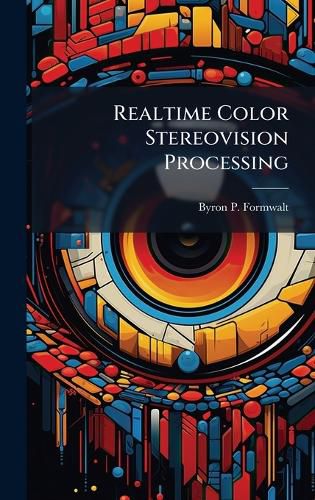
Recent developments in aviation have made micro air vehicles (MAVs) a reality. These featherweight palm-sized radio-controlled flying saucers embody the future of air-to-ground combat. No one has ever successfully implemented an autonomous control system for MAVs. Because MAVs are physically small with limited energy supplies, video signals offer superiority over radar for navigational applications. This research takes a step forward in realtime machine vision processing. It investigates techniques for implementing a realtime stereovision processing system using two miniature color cameras. The effects of poor-quality optics are overcome by a robust algorithm, which operates in realtime and achieves frame rates up to 10 fps in ideal conditions. The vision system implements innovative work in the following five areas of vision processing: fast image registration preprocessing, object detection, feature correspondence, distortion-compensated ranging, and multiscale nominal frequency-based object recognition. Results indicate that the system can provide adequate obstacle avoidance feedback for autonomous vehicle control. However, typical relative position errors are about 10%--to high for surveillance applications. The range of operation is also limited to between 6 - 30m. The root of this limitation is imprecise feature correspondence: with perfect feature correspondence the range would extend to between 0.5 - 30m. Stereo camera separation limits the near range, while optical resolution limits the far range. Image frame sizes are 160x120 pixels. Increasing this size will improve far range characteristics but will also decrease frame rate.
This work has been selected by scholars as being culturally important, and is part of the knowledge base of civilization as we know it. This work was reproduced from the original artifact, and remains as true to the original work as possible. Therefore, you will see the original copyright references, library stamps (as most of these works have been housed in our most important libraries around the world), and other notations in the work.
This work is in the public domain in the United States of America, and possibly other nations. Within the United States, you may freely copy and distribute this work, as no entity (individual or corporate) has a copyright on the body of the work.
As a reproduction of a historical artifact, this work may contain missing or blurred pages, poor pictures, errant marks, etc. Scholars believe, and we concur, that this work is important enough to be preserved, reproduced, and made generally available to the public. We appreciate your support of the preservation process, and thank you for being an important part of keeping this knowledge alive and relevant.
$9.00 standard shipping within Australia
FREE standard shipping within Australia for orders over $100.00
Express & International shipping calculated at checkout
Stock availability can be subject to change without notice. We recommend calling the shop or contacting our online team to check availability of low stock items. Please see our Shopping Online page for more details.
This title is printed to order. This book may have been self-published. If so, we cannot guarantee the quality of the content. In the main most books will have gone through the editing process however some may not. We therefore suggest that you be aware of this before ordering this book. If in doubt check either the author or publisher’s details as we are unable to accept any returns unless they are faulty. Please contact us if you have any questions.
Recent developments in aviation have made micro air vehicles (MAVs) a reality. These featherweight palm-sized radio-controlled flying saucers embody the future of air-to-ground combat. No one has ever successfully implemented an autonomous control system for MAVs. Because MAVs are physically small with limited energy supplies, video signals offer superiority over radar for navigational applications. This research takes a step forward in realtime machine vision processing. It investigates techniques for implementing a realtime stereovision processing system using two miniature color cameras. The effects of poor-quality optics are overcome by a robust algorithm, which operates in realtime and achieves frame rates up to 10 fps in ideal conditions. The vision system implements innovative work in the following five areas of vision processing: fast image registration preprocessing, object detection, feature correspondence, distortion-compensated ranging, and multiscale nominal frequency-based object recognition. Results indicate that the system can provide adequate obstacle avoidance feedback for autonomous vehicle control. However, typical relative position errors are about 10%--to high for surveillance applications. The range of operation is also limited to between 6 - 30m. The root of this limitation is imprecise feature correspondence: with perfect feature correspondence the range would extend to between 0.5 - 30m. Stereo camera separation limits the near range, while optical resolution limits the far range. Image frame sizes are 160x120 pixels. Increasing this size will improve far range characteristics but will also decrease frame rate.
This work has been selected by scholars as being culturally important, and is part of the knowledge base of civilization as we know it. This work was reproduced from the original artifact, and remains as true to the original work as possible. Therefore, you will see the original copyright references, library stamps (as most of these works have been housed in our most important libraries around the world), and other notations in the work.
This work is in the public domain in the United States of America, and possibly other nations. Within the United States, you may freely copy and distribute this work, as no entity (individual or corporate) has a copyright on the body of the work.
As a reproduction of a historical artifact, this work may contain missing or blurred pages, poor pictures, errant marks, etc. Scholars believe, and we concur, that this work is important enough to be preserved, reproduced, and made generally available to the public. We appreciate your support of the preservation process, and thank you for being an important part of keeping this knowledge alive and relevant.
Search our extensive online catalogue.
