Readings Newsletter
Become a Readings Member to make your shopping experience even easier.
Sign in or sign up for free!
You’re not far away from qualifying for FREE standard shipping within Australia
You’ve qualified for FREE standard shipping within Australia
The cart is loading…


This title is printed to order. This book may have been self-published. If so, we cannot guarantee the quality of the content. In the main most books will have gone through the editing process however some may not. We therefore suggest that you be aware of this before ordering this book. If in doubt check either the author or publisher’s details as we are unable to accept any returns unless they are faulty. Please contact us if you have any questions.
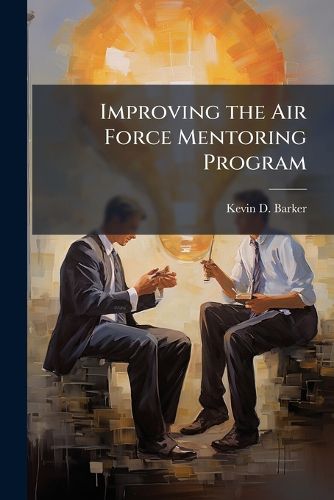
The Air Force mentoring program finds its foundation in AFI 36-3401, which provides the fundamentals for mentoring, broken out into 10 paragraphs. For a number of reasons to include faulty assumptions, a demand for immediate results and the issues associated with the all too common practice of "square filling", the mentoring program has waned. The concepts of mentoring have existed for a long time, yet only recently, within the past decade or so, have the concepts really come into their own for corporations. The Air Force began, in good faith, pursuing these concepts about seven years ago when it published the first iteration of the AFI. Because the AFI denoted a leadership directed program, rather than a leadership led culture, the concepts of mentoring have not taken hold, as they should have. One can pull "best practices" on mentoring from an endless number of sources such as corporations, government agencies and sports teams. This paper will look primarily at the best practices found at the Virginia Military Institute and International Business Machines. These two entities have mentoring solutions that are in essence a mind-set or culture imbedded in its students or employees as the case may be, rather than just a program as is currently found in the AF. If one were to take these best practices and meld them together with the information and processes found in the AFI, the Air Force mentoring program could easily grow from just a program to an all encompassing mind-set or culture; a culture of continuous learning and improvement. Some examples of these improvements include more responsibility being taken by the prot g for his/her own betterment instead of relying solely on the mentor to provide everything; who precisely should be the mentor; is the immediate supervisor the best choice, or is there someone that could provide a better mentoring environment.
This work has been selected by scholars as being culturally important, and is part of the knowledge base of civilization as we know it. This work was reproduced from the original artifact, and remains as true to the original work as possible. Therefore, you will see the original copyright references, library stamps (as most of these works have been housed in our most important libraries around the world), and other notations in the work.
This work is in the public domain in the United States of America, and possibly other nations. Within the United States, you may freely copy and distribute this work, as no entity (individual or corporate) has a copyright on the body of the work.
As a reproduction of a historical artifact, this work may contain missing or blurred pages, poor pictures, errant marks, etc. Scholars believe, and we concur, that this work is important enough to be preserved, reproduced, and made generally available to the public. We appreciate your support of the preservation process, and thank you for being an important part of keeping this knowledge alive and relevant.
$9.00 standard shipping within Australia
FREE standard shipping within Australia for orders over $100.00
Express & International shipping calculated at checkout
Stock availability can be subject to change without notice. We recommend calling the shop or contacting our online team to check availability of low stock items. Please see our Shopping Online page for more details.
This title is printed to order. This book may have been self-published. If so, we cannot guarantee the quality of the content. In the main most books will have gone through the editing process however some may not. We therefore suggest that you be aware of this before ordering this book. If in doubt check either the author or publisher’s details as we are unable to accept any returns unless they are faulty. Please contact us if you have any questions.
The Air Force mentoring program finds its foundation in AFI 36-3401, which provides the fundamentals for mentoring, broken out into 10 paragraphs. For a number of reasons to include faulty assumptions, a demand for immediate results and the issues associated with the all too common practice of "square filling", the mentoring program has waned. The concepts of mentoring have existed for a long time, yet only recently, within the past decade or so, have the concepts really come into their own for corporations. The Air Force began, in good faith, pursuing these concepts about seven years ago when it published the first iteration of the AFI. Because the AFI denoted a leadership directed program, rather than a leadership led culture, the concepts of mentoring have not taken hold, as they should have. One can pull "best practices" on mentoring from an endless number of sources such as corporations, government agencies and sports teams. This paper will look primarily at the best practices found at the Virginia Military Institute and International Business Machines. These two entities have mentoring solutions that are in essence a mind-set or culture imbedded in its students or employees as the case may be, rather than just a program as is currently found in the AF. If one were to take these best practices and meld them together with the information and processes found in the AFI, the Air Force mentoring program could easily grow from just a program to an all encompassing mind-set or culture; a culture of continuous learning and improvement. Some examples of these improvements include more responsibility being taken by the prot g for his/her own betterment instead of relying solely on the mentor to provide everything; who precisely should be the mentor; is the immediate supervisor the best choice, or is there someone that could provide a better mentoring environment.
This work has been selected by scholars as being culturally important, and is part of the knowledge base of civilization as we know it. This work was reproduced from the original artifact, and remains as true to the original work as possible. Therefore, you will see the original copyright references, library stamps (as most of these works have been housed in our most important libraries around the world), and other notations in the work.
This work is in the public domain in the United States of America, and possibly other nations. Within the United States, you may freely copy and distribute this work, as no entity (individual or corporate) has a copyright on the body of the work.
As a reproduction of a historical artifact, this work may contain missing or blurred pages, poor pictures, errant marks, etc. Scholars believe, and we concur, that this work is important enough to be preserved, reproduced, and made generally available to the public. We appreciate your support of the preservation process, and thank you for being an important part of keeping this knowledge alive and relevant.
Search our extensive online catalogue.
