Readings Newsletter
Become a Readings Member to make your shopping experience even easier.
Sign in or sign up for free!
You’re not far away from qualifying for FREE standard shipping within Australia
You’ve qualified for FREE standard shipping within Australia
The cart is loading…


This title is printed to order. This book may have been self-published. If so, we cannot guarantee the quality of the content. In the main most books will have gone through the editing process however some may not. We therefore suggest that you be aware of this before ordering this book. If in doubt check either the author or publisher’s details as we are unable to accept any returns unless they are faulty. Please contact us if you have any questions.
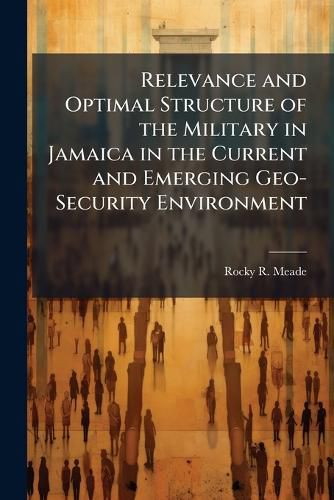
In most democratic countries that are not engaged in conflict one can expect debates regarding the amount of the gross domestic product (GDP) that is spent on national security. The issue is even more significant in small states with limited resources. The Jamaican military is occasionally the subject of such debates. The arguments raised against expenditure on an active military force, as opposed to the police force, include the view that there is no apparent conventional external threat, while the internal police-type tasks are increasing.
This study considers current and emerging threats to determine what capabilities are required to face them. Case studies of Costa Rica, Iceland, Singapore and the Eastern Caribbean States, are used to determine some of the options available for small-state security linked to the issue of sovereignty. Interviews of both military and nonmilitary experts on national security issues provide additional data for comparison and contrast. The dissertation concludes with recommendations for retaining the military's distinct character, with a reduced regular/active force structure, though not necessarily less personnel, and a significantly larger reserve component. The main theme is that Jamaica cannot afford to be complacent because the nature of security threats globally is evolving.
This work has been selected by scholars as being culturally important, and is part of the knowledge base of civilization as we know it. This work was reproduced from the original artifact, and remains as true to the original work as possible. Therefore, you will see the original copyright references, library stamps (as most of these works have been housed in our most important libraries around the world), and other notations in the work.
This work is in the public domain in the United States of America, and possibly other nations. Within the United States, you may freely copy and distribute this work, as no entity (individual or corporate) has a copyright on the body of the work.
As a reproduction of a historical artifact, this work may contain missing or blurred pages, poor pictures, errant marks, etc. Scholars believe, and we concur, that this work is important enough to be preserved, reproduced, and made generally available to the public. We appreciate your support of the preservation process, and thank you for being an important part of keeping this knowledge alive and relevant.
$9.00 standard shipping within Australia
FREE standard shipping within Australia for orders over $100.00
Express & International shipping calculated at checkout
Stock availability can be subject to change without notice. We recommend calling the shop or contacting our online team to check availability of low stock items. Please see our Shopping Online page for more details.
This title is printed to order. This book may have been self-published. If so, we cannot guarantee the quality of the content. In the main most books will have gone through the editing process however some may not. We therefore suggest that you be aware of this before ordering this book. If in doubt check either the author or publisher’s details as we are unable to accept any returns unless they are faulty. Please contact us if you have any questions.
In most democratic countries that are not engaged in conflict one can expect debates regarding the amount of the gross domestic product (GDP) that is spent on national security. The issue is even more significant in small states with limited resources. The Jamaican military is occasionally the subject of such debates. The arguments raised against expenditure on an active military force, as opposed to the police force, include the view that there is no apparent conventional external threat, while the internal police-type tasks are increasing.
This study considers current and emerging threats to determine what capabilities are required to face them. Case studies of Costa Rica, Iceland, Singapore and the Eastern Caribbean States, are used to determine some of the options available for small-state security linked to the issue of sovereignty. Interviews of both military and nonmilitary experts on national security issues provide additional data for comparison and contrast. The dissertation concludes with recommendations for retaining the military's distinct character, with a reduced regular/active force structure, though not necessarily less personnel, and a significantly larger reserve component. The main theme is that Jamaica cannot afford to be complacent because the nature of security threats globally is evolving.
This work has been selected by scholars as being culturally important, and is part of the knowledge base of civilization as we know it. This work was reproduced from the original artifact, and remains as true to the original work as possible. Therefore, you will see the original copyright references, library stamps (as most of these works have been housed in our most important libraries around the world), and other notations in the work.
This work is in the public domain in the United States of America, and possibly other nations. Within the United States, you may freely copy and distribute this work, as no entity (individual or corporate) has a copyright on the body of the work.
As a reproduction of a historical artifact, this work may contain missing or blurred pages, poor pictures, errant marks, etc. Scholars believe, and we concur, that this work is important enough to be preserved, reproduced, and made generally available to the public. We appreciate your support of the preservation process, and thank you for being an important part of keeping this knowledge alive and relevant.
Search our extensive online catalogue.
