Readings Newsletter
Become a Readings Member to make your shopping experience even easier.
Sign in or sign up for free!
You’re not far away from qualifying for FREE standard shipping within Australia
You’ve qualified for FREE standard shipping within Australia
The cart is loading…


This title is printed to order. This book may have been self-published. If so, we cannot guarantee the quality of the content. In the main most books will have gone through the editing process however some may not. We therefore suggest that you be aware of this before ordering this book. If in doubt check either the author or publisher’s details as we are unable to accept any returns unless they are faulty. Please contact us if you have any questions.
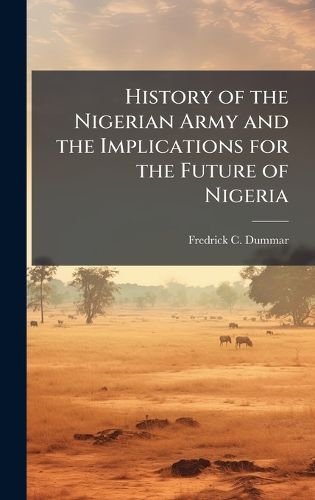
Ethnic and religious clashes have continued in Africa's most densely populated nation. Nigeria is a nation of vast human and natural resource potential that has experienced extreme strife during forty years of transition from colonial rule to democratic governance. The central research questions are: How has the historical development of Nigeria's Army effected the development of the nation-state? And how has political engagement changed the army? The first step examined the ethnic, religious factors and the history of military coups d'etat. The second step examined the effect of military governance on education, the economy, and foreign policy. The final step determined the future path of Nigeria and its Army after the birth of Nigeria's third republic. The conclusion recommended an increase in military-to-military contact with Nigeria to increase professionalism and respect for the subordination of the military to civilian authority, along with increased diplomatic efforts to help Nigerians heal the wounds of internal discord that have created the belief that military governance is the answer.
This work has been selected by scholars as being culturally important, and is part of the knowledge base of civilization as we know it. This work was reproduced from the original artifact, and remains as true to the original work as possible. Therefore, you will see the original copyright references, library stamps (as most of these works have been housed in our most important libraries around the world), and other notations in the work.
This work is in the public domain in the United States of America, and possibly other nations. Within the United States, you may freely copy and distribute this work, as no entity (individual or corporate) has a copyright on the body of the work.
As a reproduction of a historical artifact, this work may contain missing or blurred pages, poor pictures, errant marks, etc. Scholars believe, and we concur, that this work is important enough to be preserved, reproduced, and made generally available to the public. We appreciate your support of the preservation process, and thank you for being an important part of keeping this knowledge alive and relevant.
$9.00 standard shipping within Australia
FREE standard shipping within Australia for orders over $100.00
Express & International shipping calculated at checkout
Stock availability can be subject to change without notice. We recommend calling the shop or contacting our online team to check availability of low stock items. Please see our Shopping Online page for more details.
This title is printed to order. This book may have been self-published. If so, we cannot guarantee the quality of the content. In the main most books will have gone through the editing process however some may not. We therefore suggest that you be aware of this before ordering this book. If in doubt check either the author or publisher’s details as we are unable to accept any returns unless they are faulty. Please contact us if you have any questions.
Ethnic and religious clashes have continued in Africa's most densely populated nation. Nigeria is a nation of vast human and natural resource potential that has experienced extreme strife during forty years of transition from colonial rule to democratic governance. The central research questions are: How has the historical development of Nigeria's Army effected the development of the nation-state? And how has political engagement changed the army? The first step examined the ethnic, religious factors and the history of military coups d'etat. The second step examined the effect of military governance on education, the economy, and foreign policy. The final step determined the future path of Nigeria and its Army after the birth of Nigeria's third republic. The conclusion recommended an increase in military-to-military contact with Nigeria to increase professionalism and respect for the subordination of the military to civilian authority, along with increased diplomatic efforts to help Nigerians heal the wounds of internal discord that have created the belief that military governance is the answer.
This work has been selected by scholars as being culturally important, and is part of the knowledge base of civilization as we know it. This work was reproduced from the original artifact, and remains as true to the original work as possible. Therefore, you will see the original copyright references, library stamps (as most of these works have been housed in our most important libraries around the world), and other notations in the work.
This work is in the public domain in the United States of America, and possibly other nations. Within the United States, you may freely copy and distribute this work, as no entity (individual or corporate) has a copyright on the body of the work.
As a reproduction of a historical artifact, this work may contain missing or blurred pages, poor pictures, errant marks, etc. Scholars believe, and we concur, that this work is important enough to be preserved, reproduced, and made generally available to the public. We appreciate your support of the preservation process, and thank you for being an important part of keeping this knowledge alive and relevant.
Search our extensive online catalogue.
