Readings Newsletter
Become a Readings Member to make your shopping experience even easier.
Sign in or sign up for free!
You’re not far away from qualifying for FREE standard shipping within Australia
You’ve qualified for FREE standard shipping within Australia
The cart is loading…


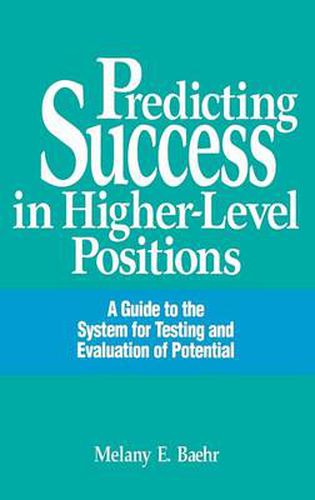
STEP is a job analysis-basis human resource management system that was specifically developed, over more than two decades of research at the Human Resources Centre of The University of Chicago, for higher-level positions in business and industrial organizations. Currently in use by major American corporations, the system is time - and cost-effective since it provides a common base for the coordination of a wide variety of human resource procedures including selection, placement, the identification of training needs, promotion, and succession planning. The system is unique in that is provides, after a single administration, estimates of potential for successful performance and assessments of the level of acquired skill in the function to be performed, not only in the present (target) position but for all vertically and horizontally linked positions in a job classification matrix that covers the vast majority of higher-level personnel. The first chapter of the book positions the STEP system with respect to current thinking in industrial-organizational psychology, briefly describes the rationale for the two interlocking measurement subsystems on which it is based, provides an empirical definition of potential , and identifies the higher-level population to which it can be applied. Chapter 2 and 3 give a review of job analysis procedures, describe the development of a job analysis instrument for the system, and discuss its applications for human resource management. Chapters 4 and 5 follow the same pattern of review, development, and application for a managerial and professional test battery. Chapter 6 thoroughly explores the system’s reliability and validity. Chapter 7 provides very practical instructions for a wide array of human resource applications, and Chapter 8 is devoted to one of its applications, the career counselling conference. The final chapter describes how the STEP programme will help human resource professonals face the challenges of the coming decades successfully. The book should be of interest to both teaching faculty and knowledgeable practitioners in industrial-organizatonal psychology.
$9.00 standard shipping within Australia
FREE standard shipping within Australia for orders over $100.00
Express & International shipping calculated at checkout
Stock availability can be subject to change without notice. We recommend calling the shop or contacting our online team to check availability of low stock items. Please see our Shopping Online page for more details.
STEP is a job analysis-basis human resource management system that was specifically developed, over more than two decades of research at the Human Resources Centre of The University of Chicago, for higher-level positions in business and industrial organizations. Currently in use by major American corporations, the system is time - and cost-effective since it provides a common base for the coordination of a wide variety of human resource procedures including selection, placement, the identification of training needs, promotion, and succession planning. The system is unique in that is provides, after a single administration, estimates of potential for successful performance and assessments of the level of acquired skill in the function to be performed, not only in the present (target) position but for all vertically and horizontally linked positions in a job classification matrix that covers the vast majority of higher-level personnel. The first chapter of the book positions the STEP system with respect to current thinking in industrial-organizational psychology, briefly describes the rationale for the two interlocking measurement subsystems on which it is based, provides an empirical definition of potential , and identifies the higher-level population to which it can be applied. Chapter 2 and 3 give a review of job analysis procedures, describe the development of a job analysis instrument for the system, and discuss its applications for human resource management. Chapters 4 and 5 follow the same pattern of review, development, and application for a managerial and professional test battery. Chapter 6 thoroughly explores the system’s reliability and validity. Chapter 7 provides very practical instructions for a wide array of human resource applications, and Chapter 8 is devoted to one of its applications, the career counselling conference. The final chapter describes how the STEP programme will help human resource professonals face the challenges of the coming decades successfully. The book should be of interest to both teaching faculty and knowledgeable practitioners in industrial-organizatonal psychology.
Search our extensive online catalogue.
