Readings Newsletter
Become a Readings Member to make your shopping experience even easier.
Sign in or sign up for free!
You’re not far away from qualifying for FREE standard shipping within Australia
You’ve qualified for FREE standard shipping within Australia
The cart is loading…


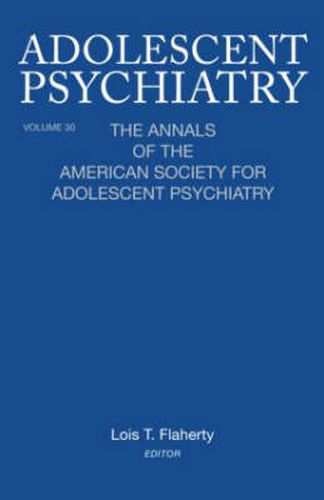
The period of adolescence can be a time of great creativity, as new intellectual capacities emerge, and as the individual adolescent attempts to make sense out of inner and outer experience. Volume 30 of Adolescent Psychiatry addresses the ways in which adolescent experience is transmuted into creative artistic production, as well as focuses on the relationship between creativity and psychopathology, and treatment for troubled adolescents.
With the links between adolescence and creativity in mind, the volume opens with an in-depth examination of a young boy’s creation of his own story of Polyphemus. This is followed by a fresh look at the adolescent influences behind Austrian Symbolist painter Gustav Klimt. The next ten chapters comprise a special section devoted to creative solutions to some of the most challenging facing adolescent psychiatry. Here, numerous relevant studies are presented and conclusions drawn, as a whole addressing topics such as: an innovative residential treatment program for gifted adolescents who have failed academically and rejected previous attempts at treatment; motivational interviewing, a technique employed in the effort to find common ground between the therapist and patient; the importance of understanding adolescent sexuality and how to approach the topic with patients in an appropriate manner; and a discussion of the registration, commitment, and assessment of juvenile sex offenders. A final section investigates problematic examples of reactive attachment disorder, as well as treatment-refractory adolescent schizophrenia - when the medication doesn’t work.
Volume 30 of Adolescent Psychiatry continues the wide-ranging scholarship and analytic sensibility that has been the hallmark of the series. Literary and artistic criticism reside comfortably between empirical research and case studies, all working together to broaden the horizon of research and application of psychiatric technique and theory for adolescence.
$9.00 standard shipping within Australia
FREE standard shipping within Australia for orders over $100.00
Express & International shipping calculated at checkout
Stock availability can be subject to change without notice. We recommend calling the shop or contacting our online team to check availability of low stock items. Please see our Shopping Online page for more details.
The period of adolescence can be a time of great creativity, as new intellectual capacities emerge, and as the individual adolescent attempts to make sense out of inner and outer experience. Volume 30 of Adolescent Psychiatry addresses the ways in which adolescent experience is transmuted into creative artistic production, as well as focuses on the relationship between creativity and psychopathology, and treatment for troubled adolescents.
With the links between adolescence and creativity in mind, the volume opens with an in-depth examination of a young boy’s creation of his own story of Polyphemus. This is followed by a fresh look at the adolescent influences behind Austrian Symbolist painter Gustav Klimt. The next ten chapters comprise a special section devoted to creative solutions to some of the most challenging facing adolescent psychiatry. Here, numerous relevant studies are presented and conclusions drawn, as a whole addressing topics such as: an innovative residential treatment program for gifted adolescents who have failed academically and rejected previous attempts at treatment; motivational interviewing, a technique employed in the effort to find common ground between the therapist and patient; the importance of understanding adolescent sexuality and how to approach the topic with patients in an appropriate manner; and a discussion of the registration, commitment, and assessment of juvenile sex offenders. A final section investigates problematic examples of reactive attachment disorder, as well as treatment-refractory adolescent schizophrenia - when the medication doesn’t work.
Volume 30 of Adolescent Psychiatry continues the wide-ranging scholarship and analytic sensibility that has been the hallmark of the series. Literary and artistic criticism reside comfortably between empirical research and case studies, all working together to broaden the horizon of research and application of psychiatric technique and theory for adolescence.
Search our extensive online catalogue.
