Readings Newsletter
Become a Readings Member to make your shopping experience even easier.
Sign in or sign up for free!
You’re not far away from qualifying for FREE standard shipping within Australia
You’ve qualified for FREE standard shipping within Australia
The cart is loading…


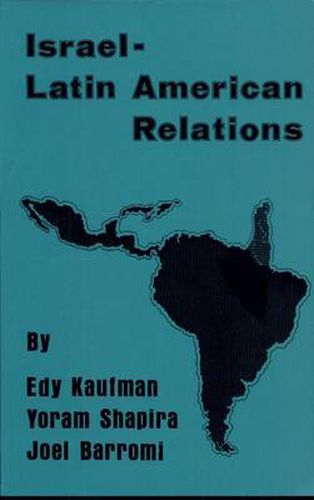
Edy Kaufman, Department of International Relations, Hebrew University of Jerusalem; Yoram Shapiro, Latin American Studies Department, Hebrew University of Jerusalem; Joe] Barromi, Director, UN Department of the Ministry for Foreign Affairs, Israel
Interaction with Latin America has held varying degrees of importance in Israel’s foreign relations. This study aims to present a comprehensive analysis of the patterns of continuity and change in Israel’s relations with Latin America over a twenty-five year period, from the creation of the state to the 1973 October War,
The authors provide a factual survey of major developments in Israeli-Latin American relations since 1948 – and evaluate the attitudes of Latin American decision makers toward Israel. This latter evaluation is accomplished by studying patterns of behavior, grouping nations according to levels of support for Israel, and analyzing the influence of different variables on the policymaking process both for each of the states involved and their interaction.
The work is divided into two basic units: background inputs and analysis of international and state relations. This division is utilized as the basis for the outputs of data and analysis on a multilateral as well as bilateral level, culminating in a detailed analysis of Latin American voting in the United Nations General Assembly.
Quite distinctive in subject and perspective. It is timely in its relevance to the Middle East conflict and the recent bid by Latin American Jead-ers for greater influence in Third World politics. I consider it a valuable addition to the literature. John J. Bailey, Associate Professor of Government, Georgetown University
This book fills a majorgap in the study of Israel’s foreign relations. It has thefurther merit of exploring a very large topic, both in time and space, within a structured systematic framework of analysis. The book is highly informative and stimulating. Michael Brecher, Professor of Political Science, McGill University
Contents:
Introduction / External Setting / Internal Setting / Israel’s Instruments / The Latin American Decision-Makers and Their Psychological Environment / Multilateral Level: Latin American Voting at the U.N. General Assembly / Bilateral Level / Concluding Remarks
$9.00 standard shipping within Australia
FREE standard shipping within Australia for orders over $100.00
Express & International shipping calculated at checkout
Stock availability can be subject to change without notice. We recommend calling the shop or contacting our online team to check availability of low stock items. Please see our Shopping Online page for more details.
Edy Kaufman, Department of International Relations, Hebrew University of Jerusalem; Yoram Shapiro, Latin American Studies Department, Hebrew University of Jerusalem; Joe] Barromi, Director, UN Department of the Ministry for Foreign Affairs, Israel
Interaction with Latin America has held varying degrees of importance in Israel’s foreign relations. This study aims to present a comprehensive analysis of the patterns of continuity and change in Israel’s relations with Latin America over a twenty-five year period, from the creation of the state to the 1973 October War,
The authors provide a factual survey of major developments in Israeli-Latin American relations since 1948 – and evaluate the attitudes of Latin American decision makers toward Israel. This latter evaluation is accomplished by studying patterns of behavior, grouping nations according to levels of support for Israel, and analyzing the influence of different variables on the policymaking process both for each of the states involved and their interaction.
The work is divided into two basic units: background inputs and analysis of international and state relations. This division is utilized as the basis for the outputs of data and analysis on a multilateral as well as bilateral level, culminating in a detailed analysis of Latin American voting in the United Nations General Assembly.
Quite distinctive in subject and perspective. It is timely in its relevance to the Middle East conflict and the recent bid by Latin American Jead-ers for greater influence in Third World politics. I consider it a valuable addition to the literature. John J. Bailey, Associate Professor of Government, Georgetown University
This book fills a majorgap in the study of Israel’s foreign relations. It has thefurther merit of exploring a very large topic, both in time and space, within a structured systematic framework of analysis. The book is highly informative and stimulating. Michael Brecher, Professor of Political Science, McGill University
Contents:
Introduction / External Setting / Internal Setting / Israel’s Instruments / The Latin American Decision-Makers and Their Psychological Environment / Multilateral Level: Latin American Voting at the U.N. General Assembly / Bilateral Level / Concluding Remarks
Search our extensive online catalogue.
