Readings Newsletter
Become a Readings Member to make your shopping experience even easier.
Sign in or sign up for free!
You’re not far away from qualifying for FREE standard shipping within Australia
You’ve qualified for FREE standard shipping within Australia
The cart is loading…


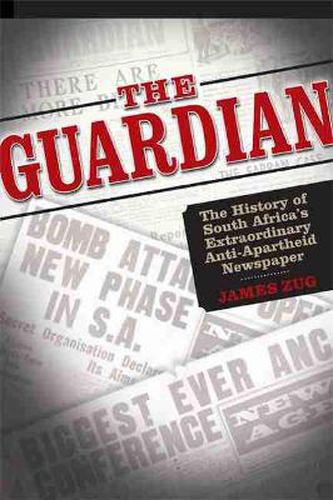
In this fascinating history of the Guardian , South Africa’s famous anti-apartheid newspaper, James Zug tells the story of a political publication that not only reported events but also helped to shape them. Between 1937 and 1963, the Guardian was the sole voice of dissent in the South African media, and Zug shows us how it played an essential role in the struggle to end apartheid.Combining a scholar’s attention to facts with a journalist’s sense of the dramatic, Zug recreates a tumultuous and dangerous era. The newspaper’s telephones were tapped, articles were censored, and staff members were jailed and deported. The apartheid regime banned the paper three times, charged it with high treason, and could only silence it completely, in 1963, by placing the entire staff under house arrest. As Zug explains, the Guardian persisted through the harassment and torment because the paper’s staff knew the significance of their work: We not only record the struggle for freedom, we are actively participating in it. When wages were kept low, when workers went on strikes, and when fascism reared its head in South Africa, the Guardian spoke up. At its height, the paper sold more than 50,000 copies a week nationally, with four bureaus across the country. As Nelson Mandela, head of the African National Congress (ANC), led the movement to end apartheid, he issued messages through the paper. Perhaps the newspaper’s most significant accomplishment, Zug writes, was uniting the ANC and the South African Communist Party. The Guardian translated Marxism into an African idiom for the ANC, bringing together the two factions that propelled the liberation struggle into a mass movement.This highly readable work is more than a perceptive look at an influential paper. It is a testament to the power of the printed word in ending injustice and changing the course of history.
$9.00 standard shipping within Australia
FREE standard shipping within Australia for orders over $100.00
Express & International shipping calculated at checkout
Stock availability can be subject to change without notice. We recommend calling the shop or contacting our online team to check availability of low stock items. Please see our Shopping Online page for more details.
In this fascinating history of the Guardian , South Africa’s famous anti-apartheid newspaper, James Zug tells the story of a political publication that not only reported events but also helped to shape them. Between 1937 and 1963, the Guardian was the sole voice of dissent in the South African media, and Zug shows us how it played an essential role in the struggle to end apartheid.Combining a scholar’s attention to facts with a journalist’s sense of the dramatic, Zug recreates a tumultuous and dangerous era. The newspaper’s telephones were tapped, articles were censored, and staff members were jailed and deported. The apartheid regime banned the paper three times, charged it with high treason, and could only silence it completely, in 1963, by placing the entire staff under house arrest. As Zug explains, the Guardian persisted through the harassment and torment because the paper’s staff knew the significance of their work: We not only record the struggle for freedom, we are actively participating in it. When wages were kept low, when workers went on strikes, and when fascism reared its head in South Africa, the Guardian spoke up. At its height, the paper sold more than 50,000 copies a week nationally, with four bureaus across the country. As Nelson Mandela, head of the African National Congress (ANC), led the movement to end apartheid, he issued messages through the paper. Perhaps the newspaper’s most significant accomplishment, Zug writes, was uniting the ANC and the South African Communist Party. The Guardian translated Marxism into an African idiom for the ANC, bringing together the two factions that propelled the liberation struggle into a mass movement.This highly readable work is more than a perceptive look at an influential paper. It is a testament to the power of the printed word in ending injustice and changing the course of history.
Search our extensive online catalogue.
