Readings Newsletter
Become a Readings Member to make your shopping experience even easier.
Sign in or sign up for free!
You’re not far away from qualifying for FREE standard shipping within Australia
You’ve qualified for FREE standard shipping within Australia
The cart is loading…


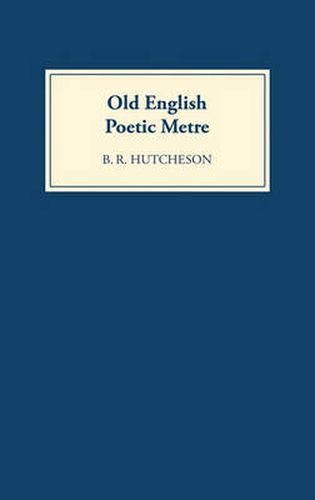
The primary aim of this study is to provide an improved description of Old English metre. Making use of a computerized database containing 13,044 lines of Old English poetry (about 40 per cent of the total which survives), it is unique among other studies of Old English metre (which have usually confined themselves to Beowulf) for the size of the corpus it examines. Although located firmly within the traditional ‘five types’ theory of Old English metre, it departs from previous critical orthodoxies in several respects. It places greater emphasis than is usual on syntax and formulaic diction, and demonstrates, for example, that a coherent metrical system emerges if alliteration is used as a guide to word stress, and that resolution is a metrically significant phenomenon. A secondary aim is to recover the way Anglo-Saxon poets composed their verse, with important implications for oral-formulaic theory; and a revised terminology is suggested.B.R. HUTCHESON teaches at Macon College, USA.
$9.00 standard shipping within Australia
FREE standard shipping within Australia for orders over $100.00
Express & International shipping calculated at checkout
Stock availability can be subject to change without notice. We recommend calling the shop or contacting our online team to check availability of low stock items. Please see our Shopping Online page for more details.
The primary aim of this study is to provide an improved description of Old English metre. Making use of a computerized database containing 13,044 lines of Old English poetry (about 40 per cent of the total which survives), it is unique among other studies of Old English metre (which have usually confined themselves to Beowulf) for the size of the corpus it examines. Although located firmly within the traditional ‘five types’ theory of Old English metre, it departs from previous critical orthodoxies in several respects. It places greater emphasis than is usual on syntax and formulaic diction, and demonstrates, for example, that a coherent metrical system emerges if alliteration is used as a guide to word stress, and that resolution is a metrically significant phenomenon. A secondary aim is to recover the way Anglo-Saxon poets composed their verse, with important implications for oral-formulaic theory; and a revised terminology is suggested.B.R. HUTCHESON teaches at Macon College, USA.
Search our extensive online catalogue.
