Readings Newsletter
Become a Readings Member to make your shopping experience even easier.
Sign in or sign up for free!
You’re not far away from qualifying for FREE standard shipping within Australia
You’ve qualified for FREE standard shipping within Australia
The cart is loading…


This title is printed to order. This book may have been self-published. If so, we cannot guarantee the quality of the content. In the main most books will have gone through the editing process however some may not. We therefore suggest that you be aware of this before ordering this book. If in doubt check either the author or publisher’s details as we are unable to accept any returns unless they are faulty. Please contact us if you have any questions.
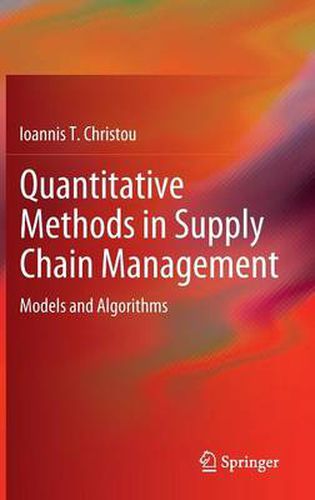
Quantitative Methods in Supply Chain Management presents some of the most important methods and tools available for modeling and solving problems arising in the context of supply chain management. In the context of this book, solving problems usually means designing efficient algorithms for obtaining high-quality solutions.
The first chapter is an extensive optimization review covering continuous unconstrained and constrained linear and nonlinear optimization algorithms, as well as dynamic programming and discrete optimization exact methods and heuristics. The second chapter presents time-series forecasting methods together with prediction market techniques for demand forecasting of new products and services. The third chapter details models and algorithms for planning and scheduling with an emphasis on production planning and personnel scheduling. The fourth chapter presents deterministic and stochastic models for inventory control with a detailed analysis on periodic review systems and algorithmic development for optimal control of such systems. The fifth chapter discusses models and algorithms for location/allocation problems arising in supply chain management, and transportation problems arising in distribution management in particular, such as the vehicle routing problem and others. The sixth and final chapter presents a short list of new trends in supply chain management with a discussion of the related challenges that each new trend might bring along in the immediate to near future.
Overall, Quantitative Methods in Supply Chain Management may be of particular interest to students and researchers in the fields of supply chain management, operations management, operations research, industrial engineering, and computer science.
$9.00 standard shipping within Australia
FREE standard shipping within Australia for orders over $100.00
Express & International shipping calculated at checkout
Stock availability can be subject to change without notice. We recommend calling the shop or contacting our online team to check availability of low stock items. Please see our Shopping Online page for more details.
This title is printed to order. This book may have been self-published. If so, we cannot guarantee the quality of the content. In the main most books will have gone through the editing process however some may not. We therefore suggest that you be aware of this before ordering this book. If in doubt check either the author or publisher’s details as we are unable to accept any returns unless they are faulty. Please contact us if you have any questions.
Quantitative Methods in Supply Chain Management presents some of the most important methods and tools available for modeling and solving problems arising in the context of supply chain management. In the context of this book, solving problems usually means designing efficient algorithms for obtaining high-quality solutions.
The first chapter is an extensive optimization review covering continuous unconstrained and constrained linear and nonlinear optimization algorithms, as well as dynamic programming and discrete optimization exact methods and heuristics. The second chapter presents time-series forecasting methods together with prediction market techniques for demand forecasting of new products and services. The third chapter details models and algorithms for planning and scheduling with an emphasis on production planning and personnel scheduling. The fourth chapter presents deterministic and stochastic models for inventory control with a detailed analysis on periodic review systems and algorithmic development for optimal control of such systems. The fifth chapter discusses models and algorithms for location/allocation problems arising in supply chain management, and transportation problems arising in distribution management in particular, such as the vehicle routing problem and others. The sixth and final chapter presents a short list of new trends in supply chain management with a discussion of the related challenges that each new trend might bring along in the immediate to near future.
Overall, Quantitative Methods in Supply Chain Management may be of particular interest to students and researchers in the fields of supply chain management, operations management, operations research, industrial engineering, and computer science.
Search our extensive online catalogue.
