Readings Newsletter
Become a Readings Member to make your shopping experience even easier.
Sign in or sign up for free!
You’re not far away from qualifying for FREE standard shipping within Australia
You’ve qualified for FREE standard shipping within Australia
The cart is loading…


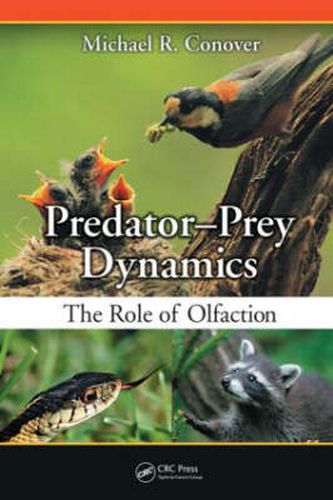
Humans, being visually oriented, are well versed in camouflage and how animals hide from predators that use vision to locate prey. However, many predators do not hunt by sight; they hunt by scent. This raises the question: do survival mechanisms and behaviors exist which allow animals to hide from these olfactory predators? If so, what are they, and how do they work?
Predator-Prey Dynamics: The Role of Olfaction examines environmental as well as biological and behavioral elements of both predators and prey to answer gaps in our current knowledge of the survival dynamics of species. Beginning with a thorough look at the mechanics of olfaction, the author explains how predators detect, locate, and track their prey using odor trails on the ground or odor plumes in the air. Understanding the physics of airflow is the next step to understanding the potential for manipulating and masking scent. While a bush may conceal an animal visually from a predator, it will not protect an animal from a predator using olfaction. To hide from the latter, an animal needs to hide in locations where turbulence and updrafts will disperse its scent.
The book addresses tradeoffs that animals must make given their dual needs to hide from predators and to procure food and water. Studies of mammalian and avian behavior provide examples on the actual use and efficacy of olfactory camouflage tactics. The book concludes with a redefinition of ecological terms based on the physics of airflow and a summary of the theory and implications of olfactory predator–prey dynamics.
Introducing the mechanics of olfaction and its influence on the behavior of both predators and prey, Predator-Prey Dynamics: The Role of Olfaction presents a new perception of the world and enables us to understand and more effectively manage the delicate survival dynamics of animals in the wild.
$9.00 standard shipping within Australia
FREE standard shipping within Australia for orders over $100.00
Express & International shipping calculated at checkout
Stock availability can be subject to change without notice. We recommend calling the shop or contacting our online team to check availability of low stock items. Please see our Shopping Online page for more details.
Humans, being visually oriented, are well versed in camouflage and how animals hide from predators that use vision to locate prey. However, many predators do not hunt by sight; they hunt by scent. This raises the question: do survival mechanisms and behaviors exist which allow animals to hide from these olfactory predators? If so, what are they, and how do they work?
Predator-Prey Dynamics: The Role of Olfaction examines environmental as well as biological and behavioral elements of both predators and prey to answer gaps in our current knowledge of the survival dynamics of species. Beginning with a thorough look at the mechanics of olfaction, the author explains how predators detect, locate, and track their prey using odor trails on the ground or odor plumes in the air. Understanding the physics of airflow is the next step to understanding the potential for manipulating and masking scent. While a bush may conceal an animal visually from a predator, it will not protect an animal from a predator using olfaction. To hide from the latter, an animal needs to hide in locations where turbulence and updrafts will disperse its scent.
The book addresses tradeoffs that animals must make given their dual needs to hide from predators and to procure food and water. Studies of mammalian and avian behavior provide examples on the actual use and efficacy of olfactory camouflage tactics. The book concludes with a redefinition of ecological terms based on the physics of airflow and a summary of the theory and implications of olfactory predator–prey dynamics.
Introducing the mechanics of olfaction and its influence on the behavior of both predators and prey, Predator-Prey Dynamics: The Role of Olfaction presents a new perception of the world and enables us to understand and more effectively manage the delicate survival dynamics of animals in the wild.
Search our extensive online catalogue.
