Readings Newsletter
Become a Readings Member to make your shopping experience even easier.
Sign in or sign up for free!
You’re not far away from qualifying for FREE standard shipping within Australia
You’ve qualified for FREE standard shipping within Australia
The cart is loading…


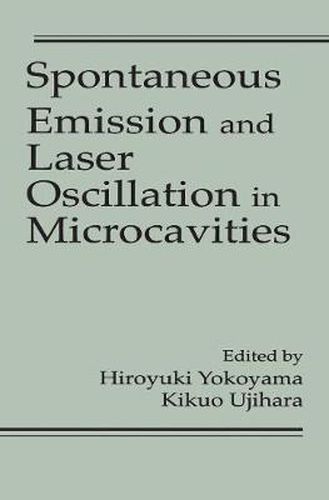
In spite of the increasing importance of microcavities, device physics or the observable phenomena in optical microcavities such as enhanced or inhibited spontaneous emission and its relation with the laser oscillation has not been systematically well-described-until now.Spontaneous Emission and Laser Oscillation in Microcavities presents the basics of optical microcavities. The volume is divided into ten chapters, each written by respected authorities in their areas.The book surveys several methods describing free space spontaneous emission and discusses changes in the feature due to the presence of a cavity. The effect of dephasing of vacuum fields on spontaneous emission in a microcavity and the effects of atomic broadening on spontaneous emission in an optical microcavity are examined. The book details the splitting in transmission peaks of planar microcavities containing semiconductor quantum wells.A simple but useful way to consider the change in the spontaneous emission rate from the viewpoint of mode density alteration by wavelength-sized cavities is provided. Authors also discuss the spontaneous emission in dielectric planar microcavities. Spontaneous emission in microcavity surface emitting lasers is covered, as are the effects of electron confinement in semiconductor quantum wells, wires, and boxes also given.The volume extends the controlling spontaneous emission phenomenon to laser oscillation. Starting from the Fermi golden rule, the microcavity laser rate equations are derived, and the oscillation characteristics are analyzed. Recent progress in optical microcavity experiments is summarized, and the applicability in massively optical parallel processing systems and demands for the device performance are explored.This volume is extremely useful as a textbook for graduate and postgraduate students and works well as a unique reference for researchers beginning to study in the field.
$9.00 standard shipping within Australia
FREE standard shipping within Australia for orders over $100.00
Express & International shipping calculated at checkout
Stock availability can be subject to change without notice. We recommend calling the shop or contacting our online team to check availability of low stock items. Please see our Shopping Online page for more details.
In spite of the increasing importance of microcavities, device physics or the observable phenomena in optical microcavities such as enhanced or inhibited spontaneous emission and its relation with the laser oscillation has not been systematically well-described-until now.Spontaneous Emission and Laser Oscillation in Microcavities presents the basics of optical microcavities. The volume is divided into ten chapters, each written by respected authorities in their areas.The book surveys several methods describing free space spontaneous emission and discusses changes in the feature due to the presence of a cavity. The effect of dephasing of vacuum fields on spontaneous emission in a microcavity and the effects of atomic broadening on spontaneous emission in an optical microcavity are examined. The book details the splitting in transmission peaks of planar microcavities containing semiconductor quantum wells.A simple but useful way to consider the change in the spontaneous emission rate from the viewpoint of mode density alteration by wavelength-sized cavities is provided. Authors also discuss the spontaneous emission in dielectric planar microcavities. Spontaneous emission in microcavity surface emitting lasers is covered, as are the effects of electron confinement in semiconductor quantum wells, wires, and boxes also given.The volume extends the controlling spontaneous emission phenomenon to laser oscillation. Starting from the Fermi golden rule, the microcavity laser rate equations are derived, and the oscillation characteristics are analyzed. Recent progress in optical microcavity experiments is summarized, and the applicability in massively optical parallel processing systems and demands for the device performance are explored.This volume is extremely useful as a textbook for graduate and postgraduate students and works well as a unique reference for researchers beginning to study in the field.
Search our extensive online catalogue.
