Readings Newsletter
Become a Readings Member to make your shopping experience even easier.
Sign in or sign up for free!
You’re not far away from qualifying for FREE standard shipping within Australia
You’ve qualified for FREE standard shipping within Australia
The cart is loading…


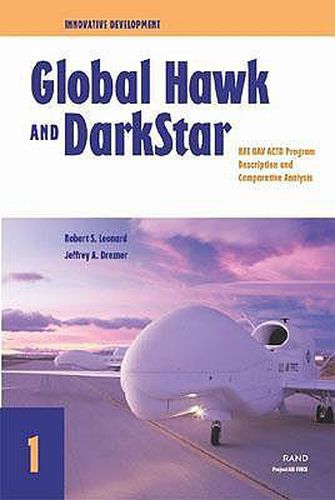
An evaluation of new acquisition strategies for the development of unmanned aerial vehicles. Over the past three decades, efforts to develop unmanned aerial vehicles have been severely hampered by escalating costs, slipped schedules, and disappointing operational results. Recently, however, the Defense Advanced Research Projects Agency, in conjunction with the Defense Airborne Reconnaissance Office, launched an initiative – designated the High-Altitude Endurance Unmanned Aerial Vehicle Advanced Concept Technology Demonstration (HAE UAV ACTD) program – whose objective was to overcome these deficits through the use of a new and innovative acquisition policy. This report evaluates several key elements of this new strategy toward the goal of determining how they affected the development of two air vehicles: the first a conventional vehicle (Global Hawk) and the second a low-observable configuration (DarkStar). The authors found that the ACTD approach required that the entire development effort be planned at the program’s inception, which proved to be a detriment to the effort as a whole. In addition, the program’s single requirement – a 10 million dollar unit flyaway price – proved unattainable and was eventually abandoned. At the same time, the authors found that the program’s designation as an ACTD, its use of Other Transaction Authority, and its delegation of considerable management responsibility to contractors greatly streamlined the oversight process and lent considerable flexibility to the effort. As a direct result of these factors, the Global Hawk program was judged to have successfully and cost-effectively produced a continuous, all-weather, wide-area surveillance capability for future warfighters. The authors thus conclude that although the DarkStar program was canceled before its capabilities could be fully demonstrated, the HAE UAV ACTD program was in aggregate a success. [AF]
$9.00 standard shipping within Australia
FREE standard shipping within Australia for orders over $100.00
Express & International shipping calculated at checkout
Stock availability can be subject to change without notice. We recommend calling the shop or contacting our online team to check availability of low stock items. Please see our Shopping Online page for more details.
An evaluation of new acquisition strategies for the development of unmanned aerial vehicles. Over the past three decades, efforts to develop unmanned aerial vehicles have been severely hampered by escalating costs, slipped schedules, and disappointing operational results. Recently, however, the Defense Advanced Research Projects Agency, in conjunction with the Defense Airborne Reconnaissance Office, launched an initiative – designated the High-Altitude Endurance Unmanned Aerial Vehicle Advanced Concept Technology Demonstration (HAE UAV ACTD) program – whose objective was to overcome these deficits through the use of a new and innovative acquisition policy. This report evaluates several key elements of this new strategy toward the goal of determining how they affected the development of two air vehicles: the first a conventional vehicle (Global Hawk) and the second a low-observable configuration (DarkStar). The authors found that the ACTD approach required that the entire development effort be planned at the program’s inception, which proved to be a detriment to the effort as a whole. In addition, the program’s single requirement – a 10 million dollar unit flyaway price – proved unattainable and was eventually abandoned. At the same time, the authors found that the program’s designation as an ACTD, its use of Other Transaction Authority, and its delegation of considerable management responsibility to contractors greatly streamlined the oversight process and lent considerable flexibility to the effort. As a direct result of these factors, the Global Hawk program was judged to have successfully and cost-effectively produced a continuous, all-weather, wide-area surveillance capability for future warfighters. The authors thus conclude that although the DarkStar program was canceled before its capabilities could be fully demonstrated, the HAE UAV ACTD program was in aggregate a success. [AF]
Search our extensive online catalogue.
