Readings Newsletter
Become a Readings Member to make your shopping experience even easier.
Sign in or sign up for free!
You’re not far away from qualifying for FREE standard shipping within Australia
You’ve qualified for FREE standard shipping within Australia
The cart is loading…


Why do Ryukyu’s official histories locate the origins of its early dynastic founders in Iheya and Izena, small islands located northwest of Okinawa? Why did the Ming court extend favorable trade terms to Ryukyuan rulers? What was the nature of Okinawa’s enigmatic principalities, Sannan, Chuzan, and Hokuzan? When and how did the Ryukyu islands become united under a single ruler? Was this Ryukyuan state an empire, why did it go to war with the powerful Japanese domain of Satsuma in 1609, and what actually happened during that war? Answers to these and other key questions concerning early Ryukyuan history can be found in this bold reappraisal by a leading authority on the subject.
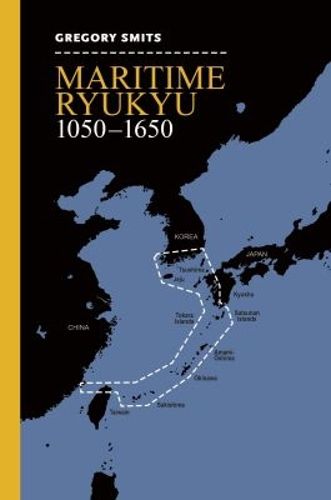
Conventional portrayals of early Ryukyu are based on official histories written between 1650 and 1750. Taking an interdisciplinary approach, Gregory Smits makes extensive use of scholarship in archaeology and anthropology and leverages unconventional sources such as the Omoro soshi (a collection of ancient songs) to present a fundamental rethinking of early Ryukyu. Instead of treating Ryukyu as a natural, self-contained cultural or political community, he examines it as part of a maritime network extending from coastal Korea to the islands of Tsushima and Iki, along the western shore of Kyushu, and through the Ryukyu Arc to coastal China.
Smits asserts that Ryukyuan culture did not spring from the soil of Okinawa: He highlights Ryukyu’s northern roots and the role of wako (pirate-merchant seafarers) in the formation of power centers throughout the islands, uncovering their close historical connections with the coastal areas of western Japan and Korea. Unlike conventional Ryukyuan histories that open with Okinawa, Maritime Ryukyu starts with the northern island of Kikai, an international crossroads during the eleventh century. It also focuses on other important but often overlooked territories such as the Tokara islands and Kumejima, in addition to bringing the northern and southern Ryukyu islands into a story that all too often centers almost exclusively on Okinawa.
Readers interested in the history of the Ryukyu islands, premodern Japan, and East Asia, as well as maritime history, will welcome this original and persuasive volume.
$9.00 standard shipping within Australia
FREE standard shipping within Australia for orders over $100.00
Express & International shipping calculated at checkout
Stock availability can be subject to change without notice. We recommend calling the shop or contacting our online team to check availability of low stock items. Please see our Shopping Online page for more details.
Why do Ryukyu’s official histories locate the origins of its early dynastic founders in Iheya and Izena, small islands located northwest of Okinawa? Why did the Ming court extend favorable trade terms to Ryukyuan rulers? What was the nature of Okinawa’s enigmatic principalities, Sannan, Chuzan, and Hokuzan? When and how did the Ryukyu islands become united under a single ruler? Was this Ryukyuan state an empire, why did it go to war with the powerful Japanese domain of Satsuma in 1609, and what actually happened during that war? Answers to these and other key questions concerning early Ryukyuan history can be found in this bold reappraisal by a leading authority on the subject.
Conventional portrayals of early Ryukyu are based on official histories written between 1650 and 1750. Taking an interdisciplinary approach, Gregory Smits makes extensive use of scholarship in archaeology and anthropology and leverages unconventional sources such as the Omoro soshi (a collection of ancient songs) to present a fundamental rethinking of early Ryukyu. Instead of treating Ryukyu as a natural, self-contained cultural or political community, he examines it as part of a maritime network extending from coastal Korea to the islands of Tsushima and Iki, along the western shore of Kyushu, and through the Ryukyu Arc to coastal China.
Smits asserts that Ryukyuan culture did not spring from the soil of Okinawa: He highlights Ryukyu’s northern roots and the role of wako (pirate-merchant seafarers) in the formation of power centers throughout the islands, uncovering their close historical connections with the coastal areas of western Japan and Korea. Unlike conventional Ryukyuan histories that open with Okinawa, Maritime Ryukyu starts with the northern island of Kikai, an international crossroads during the eleventh century. It also focuses on other important but often overlooked territories such as the Tokara islands and Kumejima, in addition to bringing the northern and southern Ryukyu islands into a story that all too often centers almost exclusively on Okinawa.
Readers interested in the history of the Ryukyu islands, premodern Japan, and East Asia, as well as maritime history, will welcome this original and persuasive volume.
Search our extensive online catalogue.
