Readings Newsletter
Become a Readings Member to make your shopping experience even easier.
Sign in or sign up for free!
You’re not far away from qualifying for FREE standard shipping within Australia
You’ve qualified for FREE standard shipping within Australia
The cart is loading…


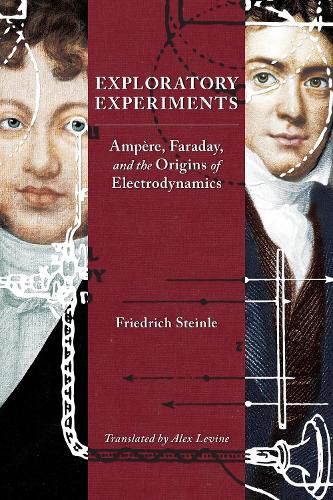
The nineteenth century was a formative period for electromagnetism and electrodynamics. Hans Christian Orsted’s groundbreaking discovery of the interaction between electricity and magnetism in 1820 inspired a wave of research, led to the science of electrodynamics, and resulted in the developmentof electromagnetic theory. Remarkably, in response, Andre-Marie Ampere and Michael Faraday developed two incompatible, competing theories. Although their approaches and conceptual frameworks were fundamentally different, together their work launched a technological revolution-laying the foundation for our modern scientific understanding of electricity- and one of the most important debates in physics, between electrodynamic action-at-a-distance and field theories.
In this foundational study, Friedrich Steinle compares the influential work of Ampere and Faraday to reveal the prominent role of exploratory experimentation in the development of science. While this exploratory phase was responsible for decisive conceptual innovations, it has yet to be examined in such great detail. Focusing on Ampere’s and Faraday’s research practices, reconstructed from previously unknown archival materials, including laboratory notes, diaries, letters, and interactions with instrument makers, this book considers both the historic and epistemological basis of exploratory experimentation and its importance to scientific development.
$9.00 standard shipping within Australia
FREE standard shipping within Australia for orders over $100.00
Express & International shipping calculated at checkout
Stock availability can be subject to change without notice. We recommend calling the shop or contacting our online team to check availability of low stock items. Please see our Shopping Online page for more details.
The nineteenth century was a formative period for electromagnetism and electrodynamics. Hans Christian Orsted’s groundbreaking discovery of the interaction between electricity and magnetism in 1820 inspired a wave of research, led to the science of electrodynamics, and resulted in the developmentof electromagnetic theory. Remarkably, in response, Andre-Marie Ampere and Michael Faraday developed two incompatible, competing theories. Although their approaches and conceptual frameworks were fundamentally different, together their work launched a technological revolution-laying the foundation for our modern scientific understanding of electricity- and one of the most important debates in physics, between electrodynamic action-at-a-distance and field theories.
In this foundational study, Friedrich Steinle compares the influential work of Ampere and Faraday to reveal the prominent role of exploratory experimentation in the development of science. While this exploratory phase was responsible for decisive conceptual innovations, it has yet to be examined in such great detail. Focusing on Ampere’s and Faraday’s research practices, reconstructed from previously unknown archival materials, including laboratory notes, diaries, letters, and interactions with instrument makers, this book considers both the historic and epistemological basis of exploratory experimentation and its importance to scientific development.
Search our extensive online catalogue.
