Readings Newsletter
Become a Readings Member to make your shopping experience even easier.
Sign in or sign up for free!
You’re not far away from qualifying for FREE standard shipping within Australia
You’ve qualified for FREE standard shipping within Australia
The cart is loading…


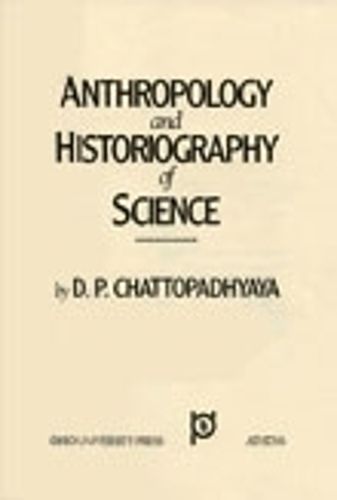
Whether history or anthropology is the most fundamental social science remains still a controversial and undecided issue. For a proper understanding of this instructive controversy, the presuppositions of these two disciplines need to be critically and philosophically reviewed. Otherwise the true perspective of the controversy remains undisclosed and therefore unintelligible. A close and comprehensive understanding of language as the basic form of the life-world provides the cues necessary to show correctly the complementary relation between anthropology and history. That synchronic or sociological and diachronic or historical perspectives of science are mutually supportive ways of representing the same social activities has been persuasively argued in this book. Chattopadhyaya has pointedly examined in this connection the conflicting views of Sartre and Levi-Strauss. Also, he has selectively drawn upon, critically assessed, and brought the theories of Husserl, Heidegger, Popper, Quine, and Kuhn to bear upon the problem. The author’s conclusion centers around his own concept of human universals. The positive thesis of the book rejects the trichotomy of three cultures: scientific, humanistic, and technological. That this view is not a theoretical creature but a historical and cultural finding has been plausibly reasoned by Chattopadhyaya. The main trend of his reasoning clearly shows that the gulf between analytic philosophers and phenomenologists is either imaginary or highly exaggerated. In this specific case, the author, a student of Popper, perceptively aruges to the effect that if theorizations is primarily problem-oriented rather than \u201cschool-based,\u201d one can see one’s way to rational solution in the convergent light of different but affine human or cultural origins. But his presentation and assessment of the views and arguments of Husseri, Popper, Quine and Kuhn are likely to prove controversial.
$9.00 standard shipping within Australia
FREE standard shipping within Australia for orders over $100.00
Express & International shipping calculated at checkout
Stock availability can be subject to change without notice. We recommend calling the shop or contacting our online team to check availability of low stock items. Please see our Shopping Online page for more details.
Whether history or anthropology is the most fundamental social science remains still a controversial and undecided issue. For a proper understanding of this instructive controversy, the presuppositions of these two disciplines need to be critically and philosophically reviewed. Otherwise the true perspective of the controversy remains undisclosed and therefore unintelligible. A close and comprehensive understanding of language as the basic form of the life-world provides the cues necessary to show correctly the complementary relation between anthropology and history. That synchronic or sociological and diachronic or historical perspectives of science are mutually supportive ways of representing the same social activities has been persuasively argued in this book. Chattopadhyaya has pointedly examined in this connection the conflicting views of Sartre and Levi-Strauss. Also, he has selectively drawn upon, critically assessed, and brought the theories of Husserl, Heidegger, Popper, Quine, and Kuhn to bear upon the problem. The author’s conclusion centers around his own concept of human universals. The positive thesis of the book rejects the trichotomy of three cultures: scientific, humanistic, and technological. That this view is not a theoretical creature but a historical and cultural finding has been plausibly reasoned by Chattopadhyaya. The main trend of his reasoning clearly shows that the gulf between analytic philosophers and phenomenologists is either imaginary or highly exaggerated. In this specific case, the author, a student of Popper, perceptively aruges to the effect that if theorizations is primarily problem-oriented rather than \u201cschool-based,\u201d one can see one’s way to rational solution in the convergent light of different but affine human or cultural origins. But his presentation and assessment of the views and arguments of Husseri, Popper, Quine and Kuhn are likely to prove controversial.
Search our extensive online catalogue.
