Readings Newsletter
Become a Readings Member to make your shopping experience even easier.
Sign in or sign up for free!
You’re not far away from qualifying for FREE standard shipping within Australia
You’ve qualified for FREE standard shipping within Australia
The cart is loading…


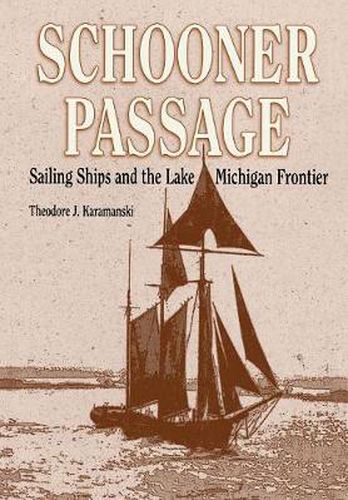
Throughout the nineteenth and early twentieth centuries, schooner trade was a well-developed system of maritime transport for commodities such as grain, lumber, and iron. The schooner trade was as critical to the development of the Great Lakes region as covered wagons were to the Far West and paddle wheel steamers were to the South.
Schooners sailed the Great Lakes in large
numbers and played a formative role in the
shaping of pioneer life throughout the region. The schooners that traveled the Lake Michigan basin succeeded in bringing a range of shoreline communities and four separate states into one coherent region. Although schooners successfully competed with steam vessels for more than a half-century, wooden sailing ships could not match the scale of the giant steel bulk carriers that began to emerge from shipyards in the twentieth century. The Mary A. Gregory–one of the last schooners left–was torched, sunk, and buried in Lake
Michigan in 1926. Schooner Passage is a
history of these magnificent sailing vessels
and their role in maritime trade along Lake
Michigan.
Theodore J. Karamanski shares with the reader the stories of the men and women who sailed on the schooners, their labor issues and strikes, the role of the schooner in the maritime economy along the Lake Michigan basin, and the factors that led to the eventual demise of that economy in the early twentieth century. Karamanski has put together historical accounts from newspaper clippings, historical society archives, and government documents to provide one of the few available histories of schooners.
Schooner Passage will interest scholars and students of Great Lakes and American history as well as the general reader interested in nineteenth-century western expansion.
$9.00 standard shipping within Australia
FREE standard shipping within Australia for orders over $100.00
Express & International shipping calculated at checkout
Stock availability can be subject to change without notice. We recommend calling the shop or contacting our online team to check availability of low stock items. Please see our Shopping Online page for more details.
Throughout the nineteenth and early twentieth centuries, schooner trade was a well-developed system of maritime transport for commodities such as grain, lumber, and iron. The schooner trade was as critical to the development of the Great Lakes region as covered wagons were to the Far West and paddle wheel steamers were to the South.
Schooners sailed the Great Lakes in large
numbers and played a formative role in the
shaping of pioneer life throughout the region. The schooners that traveled the Lake Michigan basin succeeded in bringing a range of shoreline communities and four separate states into one coherent region. Although schooners successfully competed with steam vessels for more than a half-century, wooden sailing ships could not match the scale of the giant steel bulk carriers that began to emerge from shipyards in the twentieth century. The Mary A. Gregory–one of the last schooners left–was torched, sunk, and buried in Lake
Michigan in 1926. Schooner Passage is a
history of these magnificent sailing vessels
and their role in maritime trade along Lake
Michigan.
Theodore J. Karamanski shares with the reader the stories of the men and women who sailed on the schooners, their labor issues and strikes, the role of the schooner in the maritime economy along the Lake Michigan basin, and the factors that led to the eventual demise of that economy in the early twentieth century. Karamanski has put together historical accounts from newspaper clippings, historical society archives, and government documents to provide one of the few available histories of schooners.
Schooner Passage will interest scholars and students of Great Lakes and American history as well as the general reader interested in nineteenth-century western expansion.
Search our extensive online catalogue.
