Readings Newsletter
Become a Readings Member to make your shopping experience even easier.
Sign in or sign up for free!
You’re not far away from qualifying for FREE standard shipping within Australia
You’ve qualified for FREE standard shipping within Australia
The cart is loading…


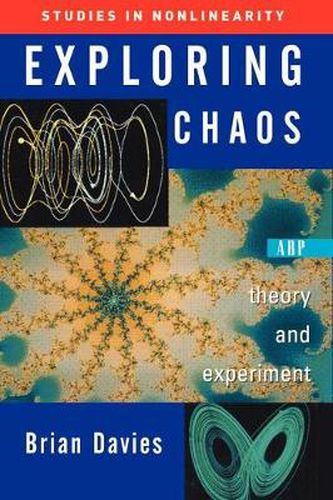
This book presents elements of the theory of chaos in dynamical systems in a framework of theoretical understanding coupled with numerical and graphical experimentation. The theory is developed using only elementary calculus and algebra, and includes dynamics of one-and two-dimensional maps, periodic orbits, stability and its quantification, chaotic behaviour, and bifurcation theory of one-dimensional systems. There is an introduction to the theory of fractals, with an emphasis on the importance of scaling, and a concluding chapter on ordinary differential equations. The accompanying software, written in Java, is available online (see link below). The program enables students to carry out their own quantitative experiments on a variety of nonlinear systems, including the analysis of fixed points of compositions of maps, calculation of Fourier spectra and Lyapunov exponents, and box counting for two-dimensional maps. It also provides for visualizing orbits, final state and bifurcation diagrams, Fourier spectra and Lyapunov exponents, basins of attractions, three-dimensional orbits, Poincare sections, and return maps. Please visit http://www.maths.anu.edu.au/briand/chaos/ for the integrated cross-platform software.
$9.00 standard shipping within Australia
FREE standard shipping within Australia for orders over $100.00
Express & International shipping calculated at checkout
Stock availability can be subject to change without notice. We recommend calling the shop or contacting our online team to check availability of low stock items. Please see our Shopping Online page for more details.
This book presents elements of the theory of chaos in dynamical systems in a framework of theoretical understanding coupled with numerical and graphical experimentation. The theory is developed using only elementary calculus and algebra, and includes dynamics of one-and two-dimensional maps, periodic orbits, stability and its quantification, chaotic behaviour, and bifurcation theory of one-dimensional systems. There is an introduction to the theory of fractals, with an emphasis on the importance of scaling, and a concluding chapter on ordinary differential equations. The accompanying software, written in Java, is available online (see link below). The program enables students to carry out their own quantitative experiments on a variety of nonlinear systems, including the analysis of fixed points of compositions of maps, calculation of Fourier spectra and Lyapunov exponents, and box counting for two-dimensional maps. It also provides for visualizing orbits, final state and bifurcation diagrams, Fourier spectra and Lyapunov exponents, basins of attractions, three-dimensional orbits, Poincare sections, and return maps. Please visit http://www.maths.anu.edu.au/briand/chaos/ for the integrated cross-platform software.
Search our extensive online catalogue.
