Readings Newsletter
Become a Readings Member to make your shopping experience even easier.
Sign in or sign up for free!
You’re not far away from qualifying for FREE standard shipping within Australia
You’ve qualified for FREE standard shipping within Australia
The cart is loading…


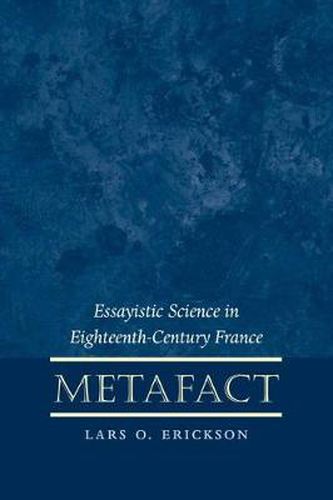
Why is science often considered the opposite of literature? Lars O. Erikson examines the relationship between these two fields in eighteenth-century France and finds that the major intellectual and scientific transitions of the period can be better understood by paying attention to literary developments, particularly in genres not traditionally associated with learned societies. Erikson examines works by Diderot and Maupertuis and identifies a shared renegade spirit he calls essayistic science. He demonstrates how the essay, a vague genre characterized by an openness to lay audiences, a self-reflective character, and an insistence on broad overviews, was used to react to a crisis in knowledge and to question the production of facts. Consequently, essayistic science does not deal with facts but with metafacts, breaking down scientific traditions and bridging objective science with subjective literature.
$9.00 standard shipping within Australia
FREE standard shipping within Australia for orders over $100.00
Express & International shipping calculated at checkout
Stock availability can be subject to change without notice. We recommend calling the shop or contacting our online team to check availability of low stock items. Please see our Shopping Online page for more details.
Why is science often considered the opposite of literature? Lars O. Erikson examines the relationship between these two fields in eighteenth-century France and finds that the major intellectual and scientific transitions of the period can be better understood by paying attention to literary developments, particularly in genres not traditionally associated with learned societies. Erikson examines works by Diderot and Maupertuis and identifies a shared renegade spirit he calls essayistic science. He demonstrates how the essay, a vague genre characterized by an openness to lay audiences, a self-reflective character, and an insistence on broad overviews, was used to react to a crisis in knowledge and to question the production of facts. Consequently, essayistic science does not deal with facts but with metafacts, breaking down scientific traditions and bridging objective science with subjective literature.
Search our extensive online catalogue.
