Readings Newsletter
Become a Readings Member to make your shopping experience even easier.
Sign in or sign up for free!
You’re not far away from qualifying for FREE standard shipping within Australia
You’ve qualified for FREE standard shipping within Australia
The cart is loading…


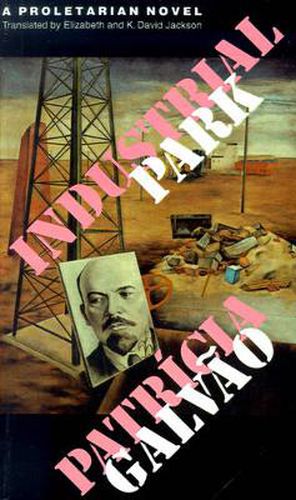
A forceful and sensitive translation, the story follows the struggles of three female workers in Sao Paulo…Through it all these strong women survive in a world where sharing popcorn with a lover is ultimately more real than all the talk of triumph of the proletariat. –Publishers Weekly A member of Brazil’s avant-garde in its heyday. Patricia Galvao (or to use her nickname, Pagu) was extraordinary. Not only was her work among the most exciting and innovative published in the 1930s, it was unique in portraying an avant-garde woman’s view of women in Sao Paulo during that audacious period. Industrial Park, first published in 1933, is Galvao’s most notable literary achieve-ment. Like Doblin’s portrayal of Berlin in Alexanderplatz or Biely’s St Petersburg, it is a book about the voices, clashes, and traffic of a city in the middle of rapid change. It includes fragments of public documents as well as dialogue and narration, giving a panorama of the city in a sequence of colorful slices. The novel dramatizes the problems of exploitation, poverty, racial prejudice, prostitution, state repression, and neocolonialism, but it is by no means a doctrinaire tract.Galvao’s ironic wit pervades the novel, aspiring not only to describe the teeming city but also to put art and politics in each other’s service. Like many of her contemporaries Galvao was a member of the Brazilian Communist Party. She attracted Party criticism for her unorthodox behavior and outspokenness. A visit to Moscow in 1934 disenchanted her with the communist state, but she continued to militate for change upon returning to Brazil. She was imprisoned and tortured under the Vargas dictatorship between 1935 and 1940. In the 1940s she returned to the public through her journalism and literary activities. She died in 1962. K. David Jackson is a professor of Portuguese language and literature at Yale University. Elizabeth Jackson coordinates a middle school curriculum project on Brazil for the Institute of Latin American Studies at the University of Texas at Austin.
$9.00 standard shipping within Australia
FREE standard shipping within Australia for orders over $100.00
Express & International shipping calculated at checkout
Stock availability can be subject to change without notice. We recommend calling the shop or contacting our online team to check availability of low stock items. Please see our Shopping Online page for more details.
A forceful and sensitive translation, the story follows the struggles of three female workers in Sao Paulo…Through it all these strong women survive in a world where sharing popcorn with a lover is ultimately more real than all the talk of triumph of the proletariat. –Publishers Weekly A member of Brazil’s avant-garde in its heyday. Patricia Galvao (or to use her nickname, Pagu) was extraordinary. Not only was her work among the most exciting and innovative published in the 1930s, it was unique in portraying an avant-garde woman’s view of women in Sao Paulo during that audacious period. Industrial Park, first published in 1933, is Galvao’s most notable literary achieve-ment. Like Doblin’s portrayal of Berlin in Alexanderplatz or Biely’s St Petersburg, it is a book about the voices, clashes, and traffic of a city in the middle of rapid change. It includes fragments of public documents as well as dialogue and narration, giving a panorama of the city in a sequence of colorful slices. The novel dramatizes the problems of exploitation, poverty, racial prejudice, prostitution, state repression, and neocolonialism, but it is by no means a doctrinaire tract.Galvao’s ironic wit pervades the novel, aspiring not only to describe the teeming city but also to put art and politics in each other’s service. Like many of her contemporaries Galvao was a member of the Brazilian Communist Party. She attracted Party criticism for her unorthodox behavior and outspokenness. A visit to Moscow in 1934 disenchanted her with the communist state, but she continued to militate for change upon returning to Brazil. She was imprisoned and tortured under the Vargas dictatorship between 1935 and 1940. In the 1940s she returned to the public through her journalism and literary activities. She died in 1962. K. David Jackson is a professor of Portuguese language and literature at Yale University. Elizabeth Jackson coordinates a middle school curriculum project on Brazil for the Institute of Latin American Studies at the University of Texas at Austin.
Search our extensive online catalogue.
