Readings Newsletter
Become a Readings Member to make your shopping experience even easier.
Sign in or sign up for free!
You’re not far away from qualifying for FREE standard shipping within Australia
You’ve qualified for FREE standard shipping within Australia
The cart is loading…


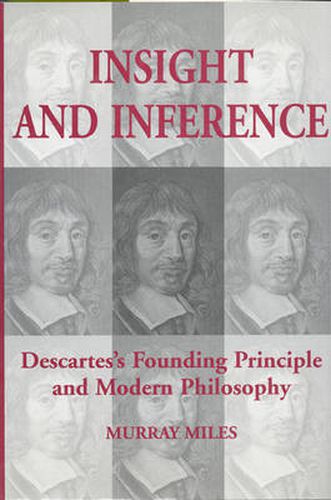
In this major re-examination of Descartes’s founding principle, cogito, ergo sum, Murray Miles presents a portrait of Descartes as the Father of Modern Philosophy that is very different from the standard one. Viewing Descartes in both a historical and a systematic perspective, Miles presents a wealth of original analyses, arguments, and re-interpretations of key texts. The result is a fresh and illuminating account of Descartes’s metaphysical project and theory of the mind. Descartes’s achievement is a radical reversal of the order of knowing, a subjectivism that places knowledge of the mind ahead of knowledge of material things, yet is free of the metaphysical idealism that some of his successors went on to embrace. A meticulous, scholarly, and exhaustive analysis, this book provides a minutely detailed reading of each word of Descartes’s founding principle, exploring in great depth the underlying epistemology and ontology. The book will fully repay a careful reading by any serious student of Descartes’s philosophy.
$9.00 standard shipping within Australia
FREE standard shipping within Australia for orders over $100.00
Express & International shipping calculated at checkout
Stock availability can be subject to change without notice. We recommend calling the shop or contacting our online team to check availability of low stock items. Please see our Shopping Online page for more details.
In this major re-examination of Descartes’s founding principle, cogito, ergo sum, Murray Miles presents a portrait of Descartes as the Father of Modern Philosophy that is very different from the standard one. Viewing Descartes in both a historical and a systematic perspective, Miles presents a wealth of original analyses, arguments, and re-interpretations of key texts. The result is a fresh and illuminating account of Descartes’s metaphysical project and theory of the mind. Descartes’s achievement is a radical reversal of the order of knowing, a subjectivism that places knowledge of the mind ahead of knowledge of material things, yet is free of the metaphysical idealism that some of his successors went on to embrace. A meticulous, scholarly, and exhaustive analysis, this book provides a minutely detailed reading of each word of Descartes’s founding principle, exploring in great depth the underlying epistemology and ontology. The book will fully repay a careful reading by any serious student of Descartes’s philosophy.
Search our extensive online catalogue.
