Readings Newsletter
Become a Readings Member to make your shopping experience even easier.
Sign in or sign up for free!
You’re not far away from qualifying for FREE standard shipping within Australia
You’ve qualified for FREE standard shipping within Australia
The cart is loading…


This title is printed to order. This book may have been self-published. If so, we cannot guarantee the quality of the content. In the main most books will have gone through the editing process however some may not. We therefore suggest that you be aware of this before ordering this book. If in doubt check either the author or publisher’s details as we are unable to accept any returns unless they are faulty. Please contact us if you have any questions.
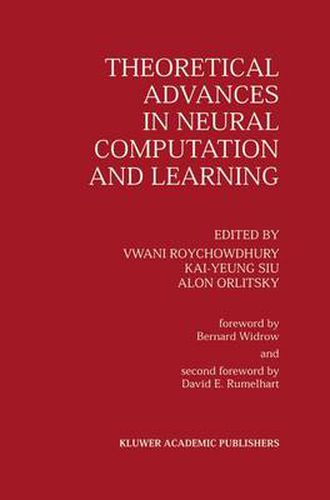
This text brings together in one volume some of the recent advances in the development of a theoretical framework for studying neural networks. A variety of novel techniques from disciplines such as computer science, electrical engineering, statistics, and mathematics have been integrated and applied to develop ground-breaking analytical tools for such studies. This volume emphasizes the computational issues in artificial neural networks and compiles a set of pioneering research works, which together establish a general framework for studying the complexity of neural networks and their learning capabilities. This volume represents one of the first efforts to highlight these fundamental results, and provides a unified platform for a theoretical exploration of neural computation. Each chapter is authored by a leading researcher and/or scholar who has made significant contributions in this area. Part 1 provides a complexity theoretic study of different models of neural computation. Complexity measures for neural models are introduced, and techniques for the efficient design of networks for performing basic computations, as well as analytical tools for understanding the capabilities and limitations of neural computation are discussed. The results describe how the computational cost of a neural network increases with the problem size. Equally important, these results go beyond the study of single neural elements, and establish to computational power of multilayer networks. Part 2 discusses concepts and results concerning learning using models of neural computation. Basic concepts such as VC-dimension and PAC-learning are introduced, and recent results relating neural networks to learning theory are derived. In addition, a number of the chapters address fundamental issues concerning learning algorithms, such as accuracy and rate of convergence, selection of training data, and efficient algorithms for learning useful classes of mappings.
$9.00 standard shipping within Australia
FREE standard shipping within Australia for orders over $100.00
Express & International shipping calculated at checkout
Stock availability can be subject to change without notice. We recommend calling the shop or contacting our online team to check availability of low stock items. Please see our Shopping Online page for more details.
This title is printed to order. This book may have been self-published. If so, we cannot guarantee the quality of the content. In the main most books will have gone through the editing process however some may not. We therefore suggest that you be aware of this before ordering this book. If in doubt check either the author or publisher’s details as we are unable to accept any returns unless they are faulty. Please contact us if you have any questions.
This text brings together in one volume some of the recent advances in the development of a theoretical framework for studying neural networks. A variety of novel techniques from disciplines such as computer science, electrical engineering, statistics, and mathematics have been integrated and applied to develop ground-breaking analytical tools for such studies. This volume emphasizes the computational issues in artificial neural networks and compiles a set of pioneering research works, which together establish a general framework for studying the complexity of neural networks and their learning capabilities. This volume represents one of the first efforts to highlight these fundamental results, and provides a unified platform for a theoretical exploration of neural computation. Each chapter is authored by a leading researcher and/or scholar who has made significant contributions in this area. Part 1 provides a complexity theoretic study of different models of neural computation. Complexity measures for neural models are introduced, and techniques for the efficient design of networks for performing basic computations, as well as analytical tools for understanding the capabilities and limitations of neural computation are discussed. The results describe how the computational cost of a neural network increases with the problem size. Equally important, these results go beyond the study of single neural elements, and establish to computational power of multilayer networks. Part 2 discusses concepts and results concerning learning using models of neural computation. Basic concepts such as VC-dimension and PAC-learning are introduced, and recent results relating neural networks to learning theory are derived. In addition, a number of the chapters address fundamental issues concerning learning algorithms, such as accuracy and rate of convergence, selection of training data, and efficient algorithms for learning useful classes of mappings.
Search our extensive online catalogue.
