Readings Newsletter
Become a Readings Member to make your shopping experience even easier.
Sign in or sign up for free!
You’re not far away from qualifying for FREE standard shipping within Australia
You’ve qualified for FREE standard shipping within Australia
The cart is loading…


This title is printed to order. This book may have been self-published. If so, we cannot guarantee the quality of the content. In the main most books will have gone through the editing process however some may not. We therefore suggest that you be aware of this before ordering this book. If in doubt check either the author or publisher’s details as we are unable to accept any returns unless they are faulty. Please contact us if you have any questions.
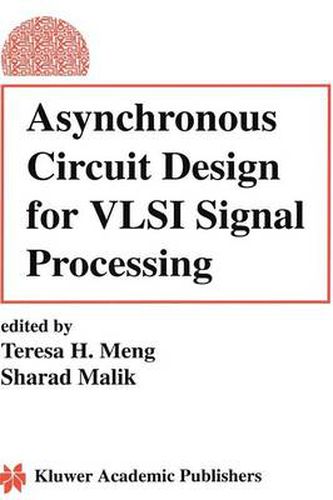
Asynchronous Circuit Design for VLSI Signal Processing is a collection of research papers on recent advances in the area of specification, design and analysis of asynchronous circuits and systems. This interest in designing digital computing systems without a global clock is prompted by the ever growing difficulty in adopting global synchronization as the only efficient means to system timing.
Asynchronous circuits and systems have long held interest for circuit designers and researchers alike because of the inherent challenge involved in designing these circuits, as well as developing design techniques for them. The frontier research in this area can be traced back to Huffman’s publications “The Synthesis of Sequential Switching Circuits’ in 1954 followed by Unger’s book, "Asynchronous Sequential Switching Circuits’ in 1969 where a theoretical foundation for handling logic hazards was established. In the last few years a growing number of researchers have joined force in unveiling the mystery of designing correct asynchronous circuits, and better yet, have produced several alternatives in automatic synthesis and verification of such circuits.
This collection of research papers represents a balanced view of current research efforts in the design, synthesis and verification of asynchronous systems.
$9.00 standard shipping within Australia
FREE standard shipping within Australia for orders over $100.00
Express & International shipping calculated at checkout
Stock availability can be subject to change without notice. We recommend calling the shop or contacting our online team to check availability of low stock items. Please see our Shopping Online page for more details.
This title is printed to order. This book may have been self-published. If so, we cannot guarantee the quality of the content. In the main most books will have gone through the editing process however some may not. We therefore suggest that you be aware of this before ordering this book. If in doubt check either the author or publisher’s details as we are unable to accept any returns unless they are faulty. Please contact us if you have any questions.
Asynchronous Circuit Design for VLSI Signal Processing is a collection of research papers on recent advances in the area of specification, design and analysis of asynchronous circuits and systems. This interest in designing digital computing systems without a global clock is prompted by the ever growing difficulty in adopting global synchronization as the only efficient means to system timing.
Asynchronous circuits and systems have long held interest for circuit designers and researchers alike because of the inherent challenge involved in designing these circuits, as well as developing design techniques for them. The frontier research in this area can be traced back to Huffman’s publications “The Synthesis of Sequential Switching Circuits’ in 1954 followed by Unger’s book, "Asynchronous Sequential Switching Circuits’ in 1969 where a theoretical foundation for handling logic hazards was established. In the last few years a growing number of researchers have joined force in unveiling the mystery of designing correct asynchronous circuits, and better yet, have produced several alternatives in automatic synthesis and verification of such circuits.
This collection of research papers represents a balanced view of current research efforts in the design, synthesis and verification of asynchronous systems.
Search our extensive online catalogue.
