Readings Newsletter
Become a Readings Member to make your shopping experience even easier.
Sign in or sign up for free!
You’re not far away from qualifying for FREE standard shipping within Australia
You’ve qualified for FREE standard shipping within Australia
The cart is loading…


This title is printed to order. This book may have been self-published. If so, we cannot guarantee the quality of the content. In the main most books will have gone through the editing process however some may not. We therefore suggest that you be aware of this before ordering this book. If in doubt check either the author or publisher’s details as we are unable to accept any returns unless they are faulty. Please contact us if you have any questions.
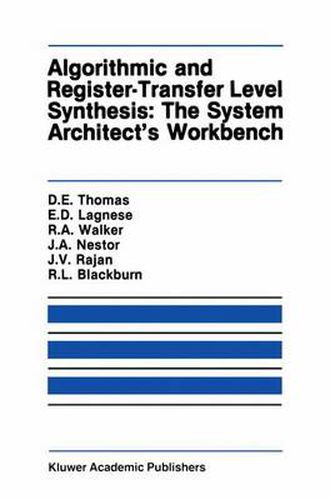
Recently there has been increased interest in the development of computer-aided design programs to support the system level designer of integrated circuits more actively. Such design tools hold the promise of raising the level of abstraction at which an integrated circuit is designed, thus releasing the current designers from many of the details of logic and circuit level design. The promise further suggests that a whole new group of designers in neighboring engineering and science disciplines, with far less understanding of integrated circuit design, will also be able to increase their productivity and the functionality of the systems they design. This promise has been made repeatedly as each new higher level of computer-aided design tool is introduced and has repeatedly fallen short of fulfillment. This book presents the results of research aimed at introducing yet higher levels of design tools that will inch the integrated circuit design community closer to the fulfillment of that promise. 1. 1. SYNTHESIS OF INTEGRATED CmCUITS In the integrated circuit (Ie) design process, a behavior that meets certain specifications is conceived for a system, the behavior is used to produce a design in terms of a set of structural logic elements, and these logic elements are mapped onto physical units. The design process is impacted by a set of constraints as well as technological information (i. e. the logic elements and physical units used for the design).
$9.00 standard shipping within Australia
FREE standard shipping within Australia for orders over $100.00
Express & International shipping calculated at checkout
Stock availability can be subject to change without notice. We recommend calling the shop or contacting our online team to check availability of low stock items. Please see our Shopping Online page for more details.
This title is printed to order. This book may have been self-published. If so, we cannot guarantee the quality of the content. In the main most books will have gone through the editing process however some may not. We therefore suggest that you be aware of this before ordering this book. If in doubt check either the author or publisher’s details as we are unable to accept any returns unless they are faulty. Please contact us if you have any questions.
Recently there has been increased interest in the development of computer-aided design programs to support the system level designer of integrated circuits more actively. Such design tools hold the promise of raising the level of abstraction at which an integrated circuit is designed, thus releasing the current designers from many of the details of logic and circuit level design. The promise further suggests that a whole new group of designers in neighboring engineering and science disciplines, with far less understanding of integrated circuit design, will also be able to increase their productivity and the functionality of the systems they design. This promise has been made repeatedly as each new higher level of computer-aided design tool is introduced and has repeatedly fallen short of fulfillment. This book presents the results of research aimed at introducing yet higher levels of design tools that will inch the integrated circuit design community closer to the fulfillment of that promise. 1. 1. SYNTHESIS OF INTEGRATED CmCUITS In the integrated circuit (Ie) design process, a behavior that meets certain specifications is conceived for a system, the behavior is used to produce a design in terms of a set of structural logic elements, and these logic elements are mapped onto physical units. The design process is impacted by a set of constraints as well as technological information (i. e. the logic elements and physical units used for the design).
Search our extensive online catalogue.
