Readings Newsletter
Become a Readings Member to make your shopping experience even easier.
Sign in or sign up for free!
You’re not far away from qualifying for FREE standard shipping within Australia
You’ve qualified for FREE standard shipping within Australia
The cart is loading…


This title is printed to order. This book may have been self-published. If so, we cannot guarantee the quality of the content. In the main most books will have gone through the editing process however some may not. We therefore suggest that you be aware of this before ordering this book. If in doubt check either the author or publisher’s details as we are unable to accept any returns unless they are faulty. Please contact us if you have any questions.
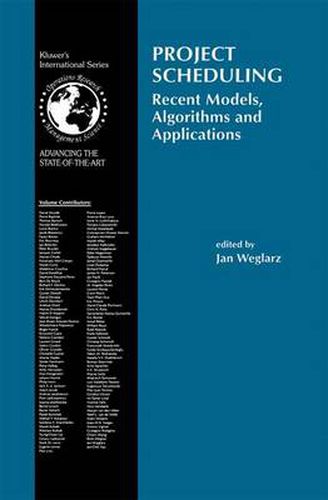
The problem of allocating scarce resources over time to perform a given set of activities - that is, project scheduling - appears in the vast spectrum of real-world situations. Over the last forty years project scheduling problems have been carefully studied, resulting in a considerable body of knowledge. Recently, however, the power and ubiquity of the computer has had a pronounced effect on research in project scheduling and project scheduling models. As a result, considerable progress has been made in all directions of modeling and finding solutions to these problems. This volume is a treatment of project scheduling in general and of recent developments in particular. Part I deals with classical models. Classical model means the deterministic problems involving discrete resources only and the evaluation of schedules on the basis of a single criterion. This term covers a wide variety of problems, including (discrete) resource-duration interaction, that is multi-mode models. Part 2 deals with heuristic algorithms for these models. It is complemented by chapters treating such important problems as benchmark instances, interval capacity consistency tests, and the evolution of software quality for (classical) project scheduling problems. In Part 3 the most important new or non-classical models are considered. These include probabilistic and fuzzy models, and continuous resources as well as multi-criteria formulations and knowledge-based systems. Part 4 contains some important extensions and/or applications of the project scheduling problems considered in the previous chapters.
$9.00 standard shipping within Australia
FREE standard shipping within Australia for orders over $100.00
Express & International shipping calculated at checkout
Stock availability can be subject to change without notice. We recommend calling the shop or contacting our online team to check availability of low stock items. Please see our Shopping Online page for more details.
This title is printed to order. This book may have been self-published. If so, we cannot guarantee the quality of the content. In the main most books will have gone through the editing process however some may not. We therefore suggest that you be aware of this before ordering this book. If in doubt check either the author or publisher’s details as we are unable to accept any returns unless they are faulty. Please contact us if you have any questions.
The problem of allocating scarce resources over time to perform a given set of activities - that is, project scheduling - appears in the vast spectrum of real-world situations. Over the last forty years project scheduling problems have been carefully studied, resulting in a considerable body of knowledge. Recently, however, the power and ubiquity of the computer has had a pronounced effect on research in project scheduling and project scheduling models. As a result, considerable progress has been made in all directions of modeling and finding solutions to these problems. This volume is a treatment of project scheduling in general and of recent developments in particular. Part I deals with classical models. Classical model means the deterministic problems involving discrete resources only and the evaluation of schedules on the basis of a single criterion. This term covers a wide variety of problems, including (discrete) resource-duration interaction, that is multi-mode models. Part 2 deals with heuristic algorithms for these models. It is complemented by chapters treating such important problems as benchmark instances, interval capacity consistency tests, and the evolution of software quality for (classical) project scheduling problems. In Part 3 the most important new or non-classical models are considered. These include probabilistic and fuzzy models, and continuous resources as well as multi-criteria formulations and knowledge-based systems. Part 4 contains some important extensions and/or applications of the project scheduling problems considered in the previous chapters.
Search our extensive online catalogue.
