Readings Newsletter
Become a Readings Member to make your shopping experience even easier.
Sign in or sign up for free!
You’re not far away from qualifying for FREE standard shipping within Australia
You’ve qualified for FREE standard shipping within Australia
The cart is loading…


This title is printed to order. This book may have been self-published. If so, we cannot guarantee the quality of the content. In the main most books will have gone through the editing process however some may not. We therefore suggest that you be aware of this before ordering this book. If in doubt check either the author or publisher’s details as we are unable to accept any returns unless they are faulty. Please contact us if you have any questions.
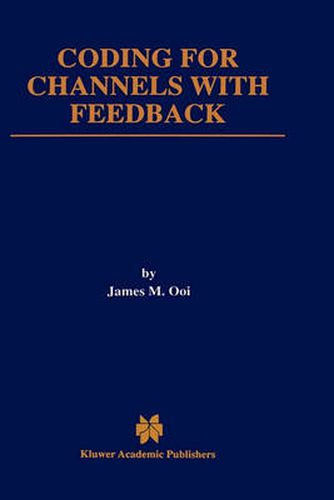
This volume presents both algorithms for feedback coding and performance analyses of these algorithms, including analyses of perhaps the most important performance criterion: computational complexity. The algorithms are developed within a single framework, termed the compressed-error-cancellation framework, where data are sent via a sequence of messages: the first message contains the original data; each subsequent message contains a source-coded description of the channel distortions introduced on the message preceding it. The text provides a framework for deriving low-complexity, practical solutions to a wide variety of feedback communication problems. It is shown that the compressed-error-cancellation framework leads to coding schemes with the lowest possible asymptotic order of growth of computations and can be applied to discrete memoryless channels, finite state channels, channels with memory, unknown channels, and multiple-access channels, all with complete noiseless feedback, as well as to channels with partial and noisy feedback. This framework leads to coding strategies that have linear complexity and are capacity achieving, and illustrates the intimate connection between source coding theory and channel coding theory. This text is a reference for researchers and communication engineers in the field of information theory, and can be used for advanced courses on the topic.
$9.00 standard shipping within Australia
FREE standard shipping within Australia for orders over $100.00
Express & International shipping calculated at checkout
Stock availability can be subject to change without notice. We recommend calling the shop or contacting our online team to check availability of low stock items. Please see our Shopping Online page for more details.
This title is printed to order. This book may have been self-published. If so, we cannot guarantee the quality of the content. In the main most books will have gone through the editing process however some may not. We therefore suggest that you be aware of this before ordering this book. If in doubt check either the author or publisher’s details as we are unable to accept any returns unless they are faulty. Please contact us if you have any questions.
This volume presents both algorithms for feedback coding and performance analyses of these algorithms, including analyses of perhaps the most important performance criterion: computational complexity. The algorithms are developed within a single framework, termed the compressed-error-cancellation framework, where data are sent via a sequence of messages: the first message contains the original data; each subsequent message contains a source-coded description of the channel distortions introduced on the message preceding it. The text provides a framework for deriving low-complexity, practical solutions to a wide variety of feedback communication problems. It is shown that the compressed-error-cancellation framework leads to coding schemes with the lowest possible asymptotic order of growth of computations and can be applied to discrete memoryless channels, finite state channels, channels with memory, unknown channels, and multiple-access channels, all with complete noiseless feedback, as well as to channels with partial and noisy feedback. This framework leads to coding strategies that have linear complexity and are capacity achieving, and illustrates the intimate connection between source coding theory and channel coding theory. This text is a reference for researchers and communication engineers in the field of information theory, and can be used for advanced courses on the topic.
Search our extensive online catalogue.
