Readings Newsletter
Become a Readings Member to make your shopping experience even easier.
Sign in or sign up for free!
You’re not far away from qualifying for FREE standard shipping within Australia
You’ve qualified for FREE standard shipping within Australia
The cart is loading…


This title is printed to order. This book may have been self-published. If so, we cannot guarantee the quality of the content. In the main most books will have gone through the editing process however some may not. We therefore suggest that you be aware of this before ordering this book. If in doubt check either the author or publisher’s details as we are unable to accept any returns unless they are faulty. Please contact us if you have any questions.
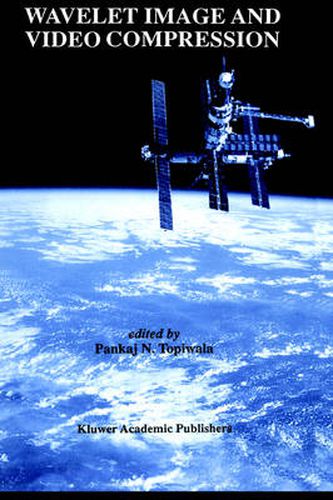
The technology of wavelet image compression has deep roots in theories of vision, and promises performance improvements over all other compression methods, such as those based on Fourier transforms, vectors quantizers, fractals, neural nets, and many others. It is this technology that is presented in this text in an accessible form. This text is divided into four parts. Part 1, Background Material, introduces the basic mathematical structures that underly image compression algorithms with the intention of providing an easy introduction to the mathematical concepts that are prerequisites for the remainder of the book. It explains such topics as change of bases, scalar and vector quantization, bit allocation and rate-distortion theory, entropy coding, the discrete-cosine transform, wavelet filters and other related topics. Part II, Still Image Coding, presents a spectrum of wavelet still image coding schemes with a special flavor in either approach or application domain. Part IV, Video Coding, examines wavelet and pyramidal coding techniques for video data.
$9.00 standard shipping within Australia
FREE standard shipping within Australia for orders over $100.00
Express & International shipping calculated at checkout
Stock availability can be subject to change without notice. We recommend calling the shop or contacting our online team to check availability of low stock items. Please see our Shopping Online page for more details.
This title is printed to order. This book may have been self-published. If so, we cannot guarantee the quality of the content. In the main most books will have gone through the editing process however some may not. We therefore suggest that you be aware of this before ordering this book. If in doubt check either the author or publisher’s details as we are unable to accept any returns unless they are faulty. Please contact us if you have any questions.
The technology of wavelet image compression has deep roots in theories of vision, and promises performance improvements over all other compression methods, such as those based on Fourier transforms, vectors quantizers, fractals, neural nets, and many others. It is this technology that is presented in this text in an accessible form. This text is divided into four parts. Part 1, Background Material, introduces the basic mathematical structures that underly image compression algorithms with the intention of providing an easy introduction to the mathematical concepts that are prerequisites for the remainder of the book. It explains such topics as change of bases, scalar and vector quantization, bit allocation and rate-distortion theory, entropy coding, the discrete-cosine transform, wavelet filters and other related topics. Part II, Still Image Coding, presents a spectrum of wavelet still image coding schemes with a special flavor in either approach or application domain. Part IV, Video Coding, examines wavelet and pyramidal coding techniques for video data.
Search our extensive online catalogue.
