Readings Newsletter
Become a Readings Member to make your shopping experience even easier.
Sign in or sign up for free!
You’re not far away from qualifying for FREE standard shipping within Australia
You’ve qualified for FREE standard shipping within Australia
The cart is loading…


This title is printed to order. This book may have been self-published. If so, we cannot guarantee the quality of the content. In the main most books will have gone through the editing process however some may not. We therefore suggest that you be aware of this before ordering this book. If in doubt check either the author or publisher’s details as we are unable to accept any returns unless they are faulty. Please contact us if you have any questions.
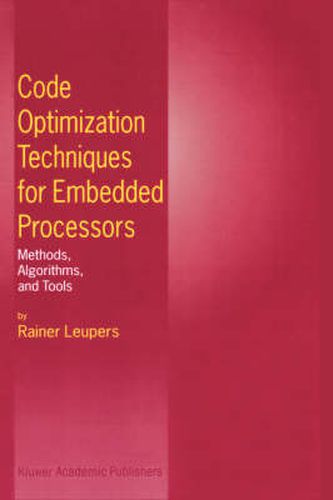
The building blocks of today’s embedded systems-on-a-chip are complex IP components and programmable processor cores. This means that more and more system functionality is implemented in software rather than in custom hardware. In turn, this indicates a growing need for high-level language compilers, capable of generating efficient code for embedded processors. However, traditional compiler technology hardly keeps pace with new developments in embedded processor architectures. Many existing compilers for DSPs and multimedia processors therefore produce code of insufficient quality with respect to performance and/or code size, and a large part of software for embedded systems is still being developed in assembly languages. As both embedded software and processors architectures are getting more and more complex, assembly programming clearly violates the demands for a short time-to-market and high dependability in embedded system design. The goal of this book is to provide new methods and techniques to software and compiler developers, that help to make the necessary step from assembly programming to the use of compilers also in embedded system design. The book discusses the state of the art in the area of compilers for embedded processors. It presents a collection of new code optimization techniques, dedicated to DSP and multimedia processors. These include: compiler support for DSP address generation units, efficient mapping of data flow graphs to irregular architectures, exploitation of SIMD and conditional instructions, and function inlining under code size constraints. Comprehensive experimental evaluations are given for real-life processors, that indicate the code quality improvements which can be achieved as compared to earlier techniques. In addition, C compiler frontend issues are discussed from a practical viewpoint. The book is intended for researchers and engineers active in software development for embedded systems, and for compiler developers in academia and industry.
$9.00 standard shipping within Australia
FREE standard shipping within Australia for orders over $100.00
Express & International shipping calculated at checkout
Stock availability can be subject to change without notice. We recommend calling the shop or contacting our online team to check availability of low stock items. Please see our Shopping Online page for more details.
This title is printed to order. This book may have been self-published. If so, we cannot guarantee the quality of the content. In the main most books will have gone through the editing process however some may not. We therefore suggest that you be aware of this before ordering this book. If in doubt check either the author or publisher’s details as we are unable to accept any returns unless they are faulty. Please contact us if you have any questions.
The building blocks of today’s embedded systems-on-a-chip are complex IP components and programmable processor cores. This means that more and more system functionality is implemented in software rather than in custom hardware. In turn, this indicates a growing need for high-level language compilers, capable of generating efficient code for embedded processors. However, traditional compiler technology hardly keeps pace with new developments in embedded processor architectures. Many existing compilers for DSPs and multimedia processors therefore produce code of insufficient quality with respect to performance and/or code size, and a large part of software for embedded systems is still being developed in assembly languages. As both embedded software and processors architectures are getting more and more complex, assembly programming clearly violates the demands for a short time-to-market and high dependability in embedded system design. The goal of this book is to provide new methods and techniques to software and compiler developers, that help to make the necessary step from assembly programming to the use of compilers also in embedded system design. The book discusses the state of the art in the area of compilers for embedded processors. It presents a collection of new code optimization techniques, dedicated to DSP and multimedia processors. These include: compiler support for DSP address generation units, efficient mapping of data flow graphs to irregular architectures, exploitation of SIMD and conditional instructions, and function inlining under code size constraints. Comprehensive experimental evaluations are given for real-life processors, that indicate the code quality improvements which can be achieved as compared to earlier techniques. In addition, C compiler frontend issues are discussed from a practical viewpoint. The book is intended for researchers and engineers active in software development for embedded systems, and for compiler developers in academia and industry.
Search our extensive online catalogue.
