Readings Newsletter
Become a Readings Member to make your shopping experience even easier.
Sign in or sign up for free!
You’re not far away from qualifying for FREE standard shipping within Australia
You’ve qualified for FREE standard shipping within Australia
The cart is loading…


This title is printed to order. This book may have been self-published. If so, we cannot guarantee the quality of the content. In the main most books will have gone through the editing process however some may not. We therefore suggest that you be aware of this before ordering this book. If in doubt check either the author or publisher’s details as we are unable to accept any returns unless they are faulty. Please contact us if you have any questions.
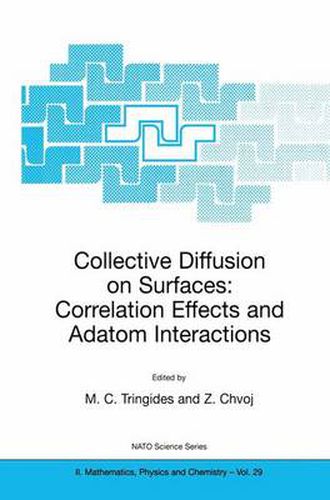
As materials research focuses into finding ways to control the growth of atomic scale structures, there is correspondingly increasing emphasis on to the problem of surface diffusion. Clearly surface diffusion is the key process, which determines how atoms move on the surface. Controlling this motion can lead to the easy fabrication of well-controlled nanostructures broadening the present possibilities in nanotechnology. The paradigm of surface diffusion has outgrown its standard textbook description as a random walk on a rigid substrate. In real systems for more complex situations are encountered: interacting atoms are commonly present on the surface with their motions highly correlated, different phases form on the surface with different dynamics, large concentration gradients drive the system far away from the linear response regime, rich metastable structures form as a result of balanced interplay between different kinetic processes, substrate relaxation can change the energy landscape and the diffusion barriers, etc. The motivation behind this ARW was to bring together the international community working on these problems. We felt that the large number of researchers, new results, and well-formulated open questions in this area require some form of integration in a single forum. The ARW and the upcoming proceedings book with papers by the majority of the participants has provided this forum. The meeting was not planned as a continuation of the earlier NATO ASI in Rhodes in 1996, although several people have participated in both meetings.
$9.00 standard shipping within Australia
FREE standard shipping within Australia for orders over $100.00
Express & International shipping calculated at checkout
Stock availability can be subject to change without notice. We recommend calling the shop or contacting our online team to check availability of low stock items. Please see our Shopping Online page for more details.
This title is printed to order. This book may have been self-published. If so, we cannot guarantee the quality of the content. In the main most books will have gone through the editing process however some may not. We therefore suggest that you be aware of this before ordering this book. If in doubt check either the author or publisher’s details as we are unable to accept any returns unless they are faulty. Please contact us if you have any questions.
As materials research focuses into finding ways to control the growth of atomic scale structures, there is correspondingly increasing emphasis on to the problem of surface diffusion. Clearly surface diffusion is the key process, which determines how atoms move on the surface. Controlling this motion can lead to the easy fabrication of well-controlled nanostructures broadening the present possibilities in nanotechnology. The paradigm of surface diffusion has outgrown its standard textbook description as a random walk on a rigid substrate. In real systems for more complex situations are encountered: interacting atoms are commonly present on the surface with their motions highly correlated, different phases form on the surface with different dynamics, large concentration gradients drive the system far away from the linear response regime, rich metastable structures form as a result of balanced interplay between different kinetic processes, substrate relaxation can change the energy landscape and the diffusion barriers, etc. The motivation behind this ARW was to bring together the international community working on these problems. We felt that the large number of researchers, new results, and well-formulated open questions in this area require some form of integration in a single forum. The ARW and the upcoming proceedings book with papers by the majority of the participants has provided this forum. The meeting was not planned as a continuation of the earlier NATO ASI in Rhodes in 1996, although several people have participated in both meetings.
Search our extensive online catalogue.
