Readings Newsletter
Become a Readings Member to make your shopping experience even easier.
Sign in or sign up for free!
You’re not far away from qualifying for FREE standard shipping within Australia
You’ve qualified for FREE standard shipping within Australia
The cart is loading…


This title is printed to order. This book may have been self-published. If so, we cannot guarantee the quality of the content. In the main most books will have gone through the editing process however some may not. We therefore suggest that you be aware of this before ordering this book. If in doubt check either the author or publisher’s details as we are unable to accept any returns unless they are faulty. Please contact us if you have any questions.
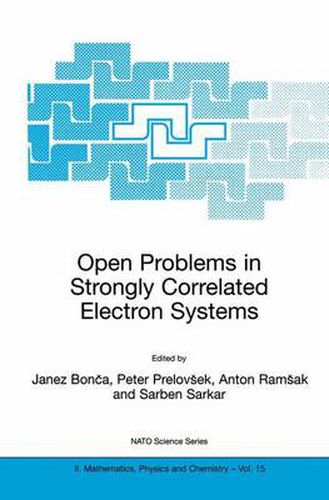
In the last decade it has become increasingly evident that strong correla- tions between electrons are an essential and unifying factor in such diverse phenomena within solid state physics as high-temperature superconductivity, colossal magnetoresistance, the quantum Hall effect, heavy-fermion metals and Coulomb blockade in single-electron transistors. A new paradigmofnon- FermiLiquidbehaviourisalsoemergingand, inanumberofsystems, replacing the Fermi liquid, which has been the cornerstone ofthe physics of metals and superconductors for the pastdecades. In spite of major achievements, the theoretical studies and understanding of strongly-correlated electrons seems to be still in its infancy. Anomalous electron properties have been studied in some generic models of correlated electrons, such as the Hubbard and t-J models, the Anderson and Kondo impurity models, and their lattice equivalents. New insights into the behaviour of these, and related models is emerging from the introduction of powerful numerical methods to study such many-body models, including approximate techniquesofmany-body theory and exactresults inlow-andhigh-dimensional systems. Theseall showconvincingevidenceforbreakdownoftheFermiliquid concept. The Bled workshop focused on several major open questions in the theory of anomalous metals with correlated electrons. These theoretical advances were complemented by the latest experimental results in related materials, presented by leading experimentalists in the field. The main emphasis was on the following topics: - physics ofcuprates and high-temperature superconductors, - charge- and spin-ordering and fluctuations, - manganites and colossal magnetoresistance, - low-dimensional systems and transport, - Mott-Hubbard transition and infinite dimensional systems, - quantum Hall effect.
$9.00 standard shipping within Australia
FREE standard shipping within Australia for orders over $100.00
Express & International shipping calculated at checkout
Stock availability can be subject to change without notice. We recommend calling the shop or contacting our online team to check availability of low stock items. Please see our Shopping Online page for more details.
This title is printed to order. This book may have been self-published. If so, we cannot guarantee the quality of the content. In the main most books will have gone through the editing process however some may not. We therefore suggest that you be aware of this before ordering this book. If in doubt check either the author or publisher’s details as we are unable to accept any returns unless they are faulty. Please contact us if you have any questions.
In the last decade it has become increasingly evident that strong correla- tions between electrons are an essential and unifying factor in such diverse phenomena within solid state physics as high-temperature superconductivity, colossal magnetoresistance, the quantum Hall effect, heavy-fermion metals and Coulomb blockade in single-electron transistors. A new paradigmofnon- FermiLiquidbehaviourisalsoemergingand, inanumberofsystems, replacing the Fermi liquid, which has been the cornerstone ofthe physics of metals and superconductors for the pastdecades. In spite of major achievements, the theoretical studies and understanding of strongly-correlated electrons seems to be still in its infancy. Anomalous electron properties have been studied in some generic models of correlated electrons, such as the Hubbard and t-J models, the Anderson and Kondo impurity models, and their lattice equivalents. New insights into the behaviour of these, and related models is emerging from the introduction of powerful numerical methods to study such many-body models, including approximate techniquesofmany-body theory and exactresults inlow-andhigh-dimensional systems. Theseall showconvincingevidenceforbreakdownoftheFermiliquid concept. The Bled workshop focused on several major open questions in the theory of anomalous metals with correlated electrons. These theoretical advances were complemented by the latest experimental results in related materials, presented by leading experimentalists in the field. The main emphasis was on the following topics: - physics ofcuprates and high-temperature superconductors, - charge- and spin-ordering and fluctuations, - manganites and colossal magnetoresistance, - low-dimensional systems and transport, - Mott-Hubbard transition and infinite dimensional systems, - quantum Hall effect.
Search our extensive online catalogue.
