Readings Newsletter
Become a Readings Member to make your shopping experience even easier.
Sign in or sign up for free!
You’re not far away from qualifying for FREE standard shipping within Australia
You’ve qualified for FREE standard shipping within Australia
The cart is loading…


This title is printed to order. This book may have been self-published. If so, we cannot guarantee the quality of the content. In the main most books will have gone through the editing process however some may not. We therefore suggest that you be aware of this before ordering this book. If in doubt check either the author or publisher’s details as we are unable to accept any returns unless they are faulty. Please contact us if you have any questions.
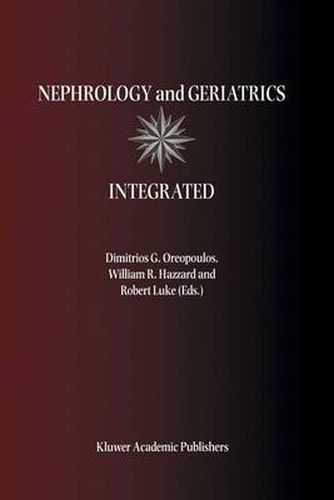
Because of many advances in medicine and biotechnology, an increasing number of individuals are surviving into old age, and we are now challenged to apply sophisticated medical knowledge to the care of the elderly citizen. In nephrology, individuals older than 65 are the fastest-growing group of patients requiring dialysis. Similarly, in increasing numbers, elderly persons present themselves with renal complaints to their family doctor, the geriatrician or the nephrologist. In August 1998, with the financial support of the John A. Hartford Foundation, leaders in geriatrics, nephrology and urology met in Jasper, Alberta, for one week to discuss their areas of special knowledge and to learn from each other. Geriatricians learned from nephrologists, nephrologists learned from geriatricians, and both came to see that they had much in common. All participants discovered a common interest, challenge and commitment, namely, to provide the best renal care to a progressively ageing population and to teach their fellows the principles of the other collaborating specialties. This book contains all the papers presented at this meeting and also the text of group discussions on Training and Education, Special Clinical Problems in Geriatric Patients, and Recommendations in Basic and Clinical Research.
$9.00 standard shipping within Australia
FREE standard shipping within Australia for orders over $100.00
Express & International shipping calculated at checkout
Stock availability can be subject to change without notice. We recommend calling the shop or contacting our online team to check availability of low stock items. Please see our Shopping Online page for more details.
This title is printed to order. This book may have been self-published. If so, we cannot guarantee the quality of the content. In the main most books will have gone through the editing process however some may not. We therefore suggest that you be aware of this before ordering this book. If in doubt check either the author or publisher’s details as we are unable to accept any returns unless they are faulty. Please contact us if you have any questions.
Because of many advances in medicine and biotechnology, an increasing number of individuals are surviving into old age, and we are now challenged to apply sophisticated medical knowledge to the care of the elderly citizen. In nephrology, individuals older than 65 are the fastest-growing group of patients requiring dialysis. Similarly, in increasing numbers, elderly persons present themselves with renal complaints to their family doctor, the geriatrician or the nephrologist. In August 1998, with the financial support of the John A. Hartford Foundation, leaders in geriatrics, nephrology and urology met in Jasper, Alberta, for one week to discuss their areas of special knowledge and to learn from each other. Geriatricians learned from nephrologists, nephrologists learned from geriatricians, and both came to see that they had much in common. All participants discovered a common interest, challenge and commitment, namely, to provide the best renal care to a progressively ageing population and to teach their fellows the principles of the other collaborating specialties. This book contains all the papers presented at this meeting and also the text of group discussions on Training and Education, Special Clinical Problems in Geriatric Patients, and Recommendations in Basic and Clinical Research.
Search our extensive online catalogue.
