Readings Newsletter
Become a Readings Member to make your shopping experience even easier.
Sign in or sign up for free!
You’re not far away from qualifying for FREE standard shipping within Australia
You’ve qualified for FREE standard shipping within Australia
The cart is loading…


This title is printed to order. This book may have been self-published. If so, we cannot guarantee the quality of the content. In the main most books will have gone through the editing process however some may not. We therefore suggest that you be aware of this before ordering this book. If in doubt check either the author or publisher’s details as we are unable to accept any returns unless they are faulty. Please contact us if you have any questions.
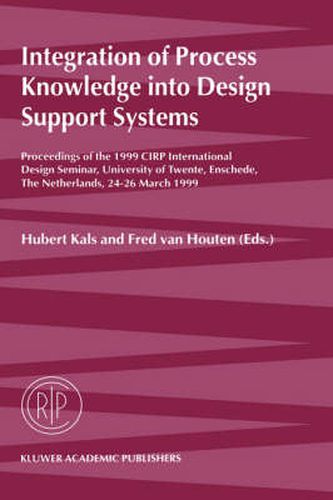
This text presents selected papers from the 1999 CIRP International Design Seminar. Design is a fundamental creative human activity. This certainly applies to the design of artifacts, the realization of which has to meet ever increasing demands. All ideas for new and better artifacts have been elaborated by designers, who have turned them into feasible concepts and finally transformed them into realisable product models. Design knowledge is difficult to capture. Design, as a process, is difficult to organize. The analysis and structuring of design (process) knowledge is necessary in order to build design support systems. Furthermore, substantial research effort is still needed to develop design as a science of synthesis. The principles of synthesis need to be better understood before design methods and computer support tools can be developed, which are fit for integration in the industrial manufacturing process. This volume includes an introduction to design theories and methods, design and engineering processes, the role of computer support tools, and artificial intelligence in design support. The other contributions can be divided roughly into two categories. The first category deals with design support tools in relation to such topics as conceptual design, collaborative design, modelling, design optimization and evaluation. The second category treats the control of design and engineering processes in relation to subjects such as product and process knowledge, process representation, synthesis of thought and methods, integration, and concurrency.
$9.00 standard shipping within Australia
FREE standard shipping within Australia for orders over $100.00
Express & International shipping calculated at checkout
Stock availability can be subject to change without notice. We recommend calling the shop or contacting our online team to check availability of low stock items. Please see our Shopping Online page for more details.
This title is printed to order. This book may have been self-published. If so, we cannot guarantee the quality of the content. In the main most books will have gone through the editing process however some may not. We therefore suggest that you be aware of this before ordering this book. If in doubt check either the author or publisher’s details as we are unable to accept any returns unless they are faulty. Please contact us if you have any questions.
This text presents selected papers from the 1999 CIRP International Design Seminar. Design is a fundamental creative human activity. This certainly applies to the design of artifacts, the realization of which has to meet ever increasing demands. All ideas for new and better artifacts have been elaborated by designers, who have turned them into feasible concepts and finally transformed them into realisable product models. Design knowledge is difficult to capture. Design, as a process, is difficult to organize. The analysis and structuring of design (process) knowledge is necessary in order to build design support systems. Furthermore, substantial research effort is still needed to develop design as a science of synthesis. The principles of synthesis need to be better understood before design methods and computer support tools can be developed, which are fit for integration in the industrial manufacturing process. This volume includes an introduction to design theories and methods, design and engineering processes, the role of computer support tools, and artificial intelligence in design support. The other contributions can be divided roughly into two categories. The first category deals with design support tools in relation to such topics as conceptual design, collaborative design, modelling, design optimization and evaluation. The second category treats the control of design and engineering processes in relation to subjects such as product and process knowledge, process representation, synthesis of thought and methods, integration, and concurrency.
Search our extensive online catalogue.
