Readings Newsletter
Become a Readings Member to make your shopping experience even easier.
Sign in or sign up for free!
You’re not far away from qualifying for FREE standard shipping within Australia
You’ve qualified for FREE standard shipping within Australia
The cart is loading…


This title is printed to order. This book may have been self-published. If so, we cannot guarantee the quality of the content. In the main most books will have gone through the editing process however some may not. We therefore suggest that you be aware of this before ordering this book. If in doubt check either the author or publisher’s details as we are unable to accept any returns unless they are faulty. Please contact us if you have any questions.
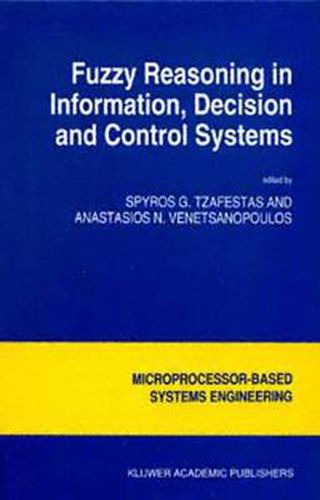
This book is devoted to the study of fuzzy reasoning as applied to decision-making and control processes. It contains a collection of contributions covering a wide range of topics within the field. It contains 21 papers, written by 34 contributors and is divided into five parts. Part 1 involves four chapters providing background material together with useful techniques for the validation of fuzzy knowledge bases and the software representation of fuzzy sets and fuzzy logic. Part 2 presents an overview of neuro-fuzzy expert systems along with an important case study, and a neural network model which is suitable for fuzzy reasoning. Part 3 presents the state of the art of fuzzy controllers, including design and implementation aspects. This part starts with a chapter on the demystification of fuzzy control and includes critical evaluations of fuzzy controllers, along with new types of fuzzy controllers such as the sliding mode fuzzy controller. Part 4 involves a chapter on fuzzy parameter and state estimation, which is of fundamental importance in a variety of applications, a chapter on fuzzy reasoning as used in rule-based systems, and a chapter on computing the multivariable shape of an n-D pattern class. Finally, Part 5 presents six important applications dealing with industrial robotic systems, mechanical systems, manipulators with artificial rubber muscles, Petri nets, biomedical engineering, and non-destructive fruit collection. The book is suitable for researchers and practitioners, as well as for teachers and students in related master and doctoral courses.
$9.00 standard shipping within Australia
FREE standard shipping within Australia for orders over $100.00
Express & International shipping calculated at checkout
Stock availability can be subject to change without notice. We recommend calling the shop or contacting our online team to check availability of low stock items. Please see our Shopping Online page for more details.
This title is printed to order. This book may have been self-published. If so, we cannot guarantee the quality of the content. In the main most books will have gone through the editing process however some may not. We therefore suggest that you be aware of this before ordering this book. If in doubt check either the author or publisher’s details as we are unable to accept any returns unless they are faulty. Please contact us if you have any questions.
This book is devoted to the study of fuzzy reasoning as applied to decision-making and control processes. It contains a collection of contributions covering a wide range of topics within the field. It contains 21 papers, written by 34 contributors and is divided into five parts. Part 1 involves four chapters providing background material together with useful techniques for the validation of fuzzy knowledge bases and the software representation of fuzzy sets and fuzzy logic. Part 2 presents an overview of neuro-fuzzy expert systems along with an important case study, and a neural network model which is suitable for fuzzy reasoning. Part 3 presents the state of the art of fuzzy controllers, including design and implementation aspects. This part starts with a chapter on the demystification of fuzzy control and includes critical evaluations of fuzzy controllers, along with new types of fuzzy controllers such as the sliding mode fuzzy controller. Part 4 involves a chapter on fuzzy parameter and state estimation, which is of fundamental importance in a variety of applications, a chapter on fuzzy reasoning as used in rule-based systems, and a chapter on computing the multivariable shape of an n-D pattern class. Finally, Part 5 presents six important applications dealing with industrial robotic systems, mechanical systems, manipulators with artificial rubber muscles, Petri nets, biomedical engineering, and non-destructive fruit collection. The book is suitable for researchers and practitioners, as well as for teachers and students in related master and doctoral courses.
Search our extensive online catalogue.
