Readings Newsletter
Become a Readings Member to make your shopping experience even easier.
Sign in or sign up for free!
You’re not far away from qualifying for FREE standard shipping within Australia
You’ve qualified for FREE standard shipping within Australia
The cart is loading…


This title is printed to order. This book may have been self-published. If so, we cannot guarantee the quality of the content. In the main most books will have gone through the editing process however some may not. We therefore suggest that you be aware of this before ordering this book. If in doubt check either the author or publisher’s details as we are unable to accept any returns unless they are faulty. Please contact us if you have any questions.
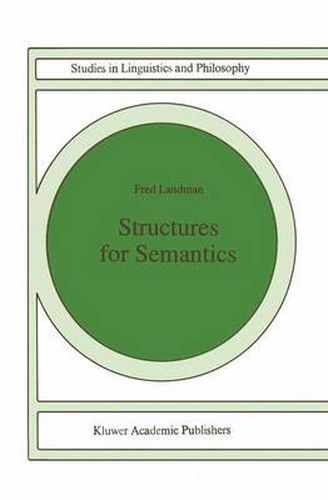
Formalization plays an important role in semantics. Doing semantics and following the literature requires considerable technical sophistica tion and acquaintance with quite advanced mathematical techniques and structures. But semantics isn’t mathematics. These techniques and structures are tools that help us build semantic theories. Our real aim is to understand semantic phenomena and we need the technique to make our understanding of these phenomena precise. The problems in semantics are most often too hard and slippery, to completely trust our informal understanding of them. This should not be taken as an attack on informal reasoning in semantics. On the contrary, in my view, very often the essential insight in a diagnosis of what is going on in a certain semantic phenomenon takes place at the informal level. It is very easy, however, to be misled into thinking that a certain informal insight provides a satisfying analysis of a certain problem; it will often turn out that there is a fundamental unclarity about what the informal insight actually is. Formalization helps to sharpen those insights and put them to the test.
$9.00 standard shipping within Australia
FREE standard shipping within Australia for orders over $100.00
Express & International shipping calculated at checkout
Stock availability can be subject to change without notice. We recommend calling the shop or contacting our online team to check availability of low stock items. Please see our Shopping Online page for more details.
This title is printed to order. This book may have been self-published. If so, we cannot guarantee the quality of the content. In the main most books will have gone through the editing process however some may not. We therefore suggest that you be aware of this before ordering this book. If in doubt check either the author or publisher’s details as we are unable to accept any returns unless they are faulty. Please contact us if you have any questions.
Formalization plays an important role in semantics. Doing semantics and following the literature requires considerable technical sophistica tion and acquaintance with quite advanced mathematical techniques and structures. But semantics isn’t mathematics. These techniques and structures are tools that help us build semantic theories. Our real aim is to understand semantic phenomena and we need the technique to make our understanding of these phenomena precise. The problems in semantics are most often too hard and slippery, to completely trust our informal understanding of them. This should not be taken as an attack on informal reasoning in semantics. On the contrary, in my view, very often the essential insight in a diagnosis of what is going on in a certain semantic phenomenon takes place at the informal level. It is very easy, however, to be misled into thinking that a certain informal insight provides a satisfying analysis of a certain problem; it will often turn out that there is a fundamental unclarity about what the informal insight actually is. Formalization helps to sharpen those insights and put them to the test.
Search our extensive online catalogue.
