Readings Newsletter
Become a Readings Member to make your shopping experience even easier.
Sign in or sign up for free!
You’re not far away from qualifying for FREE standard shipping within Australia
You’ve qualified for FREE standard shipping within Australia
The cart is loading…


This title is printed to order. This book may have been self-published. If so, we cannot guarantee the quality of the content. In the main most books will have gone through the editing process however some may not. We therefore suggest that you be aware of this before ordering this book. If in doubt check either the author or publisher’s details as we are unable to accept any returns unless they are faulty. Please contact us if you have any questions.
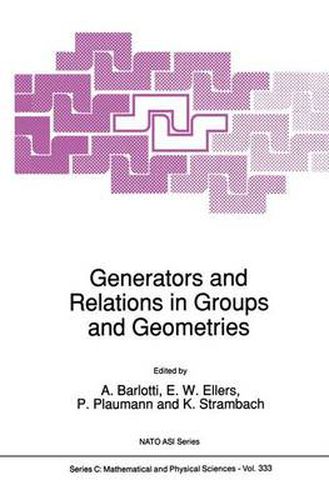
Every group is represented in many ways as an epimorphic image of a free group. It seems therefore futile to search for methods involving generators and relations which can be used to detect the structure of a group. Nevertheless, results in the indicated direction exist. The clue is to ask the right question. Classical geometry is a typical example in which the factorization of a motion into reflections or, more generally, of a collineation into central collineations, supplies valuable information on the geometric and algebraic structure. This mode of investigation has gained momentum since the end of last century. The tradition of geometric-algebraic interplay brought forward two branches of research which are documented in Parts I and II of these Proceedings. Part II deals with the theory of reflection geometry which culminated in Bachmann’s work where the geometric information is encoded in properties of the group of motions expressed by relations in the generating involutions. This approach is the backbone of the classification of motion groups for the classical unitary and orthogonal planes. The axioms in this char acterization are natural and plausible. They provoke the study of consequences of subsets of axioms which also yield natural geometries whose exploration is rewarding. Bachmann’s central axiom is the three reflection theorem, showing that the number of reflections needed to express a motion is of great importance.
$9.00 standard shipping within Australia
FREE standard shipping within Australia for orders over $100.00
Express & International shipping calculated at checkout
Stock availability can be subject to change without notice. We recommend calling the shop or contacting our online team to check availability of low stock items. Please see our Shopping Online page for more details.
This title is printed to order. This book may have been self-published. If so, we cannot guarantee the quality of the content. In the main most books will have gone through the editing process however some may not. We therefore suggest that you be aware of this before ordering this book. If in doubt check either the author or publisher’s details as we are unable to accept any returns unless they are faulty. Please contact us if you have any questions.
Every group is represented in many ways as an epimorphic image of a free group. It seems therefore futile to search for methods involving generators and relations which can be used to detect the structure of a group. Nevertheless, results in the indicated direction exist. The clue is to ask the right question. Classical geometry is a typical example in which the factorization of a motion into reflections or, more generally, of a collineation into central collineations, supplies valuable information on the geometric and algebraic structure. This mode of investigation has gained momentum since the end of last century. The tradition of geometric-algebraic interplay brought forward two branches of research which are documented in Parts I and II of these Proceedings. Part II deals with the theory of reflection geometry which culminated in Bachmann’s work where the geometric information is encoded in properties of the group of motions expressed by relations in the generating involutions. This approach is the backbone of the classification of motion groups for the classical unitary and orthogonal planes. The axioms in this char acterization are natural and plausible. They provoke the study of consequences of subsets of axioms which also yield natural geometries whose exploration is rewarding. Bachmann’s central axiom is the three reflection theorem, showing that the number of reflections needed to express a motion is of great importance.
Search our extensive online catalogue.
