Readings Newsletter
Become a Readings Member to make your shopping experience even easier.
Sign in or sign up for free!
You’re not far away from qualifying for FREE standard shipping within Australia
You’ve qualified for FREE standard shipping within Australia
The cart is loading…


This title is printed to order. This book may have been self-published. If so, we cannot guarantee the quality of the content. In the main most books will have gone through the editing process however some may not. We therefore suggest that you be aware of this before ordering this book. If in doubt check either the author or publisher’s details as we are unable to accept any returns unless they are faulty. Please contact us if you have any questions.
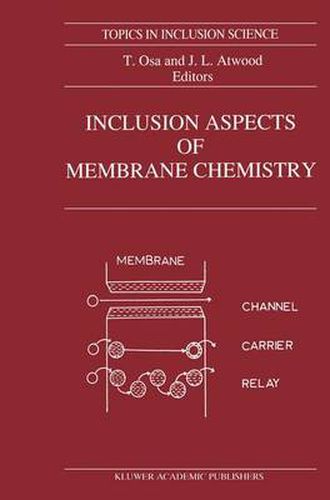
There is no doubt that the field of artificial membrane transport using synthetic ionophores has advanced remarkably in the past 15 years due primarily to the synthesis of new ionophores. Even though the theoretical framework substantially predated this activity, the merging of theory with transport experiment has often been sketchy. The purpose of this outline has been to examine key examples to illustrate the underlying principles and to suggest how experimental variables dominate the results obtained. To a very good approximation the assumption of a diffusion regime is often justified, is easily confirmed experimentally and provides a clear framework for exploitation of the inherent selectivity of a given ionophore. Thus for synthetic chemists who wish a quick and nasty experiment to examine the question of selectivity, the recipe is clear: a mixture containing all ions of interest in a standard experiment for each ligand of interest using a moderately stirred (100-200 rpm) cell and analysis of the mixture produced on the OUT side of the cell at a fixed, small extent of transport. Together with duplicates and controls, this modest set of experiments will place the results on an unambiguous footing from which clear conclusions about each ionophore’s characteristics are readily obtained. For those with more detailed interests in the transport process the demands are correspondingly higher.
$9.00 standard shipping within Australia
FREE standard shipping within Australia for orders over $100.00
Express & International shipping calculated at checkout
Stock availability can be subject to change without notice. We recommend calling the shop or contacting our online team to check availability of low stock items. Please see our Shopping Online page for more details.
This title is printed to order. This book may have been self-published. If so, we cannot guarantee the quality of the content. In the main most books will have gone through the editing process however some may not. We therefore suggest that you be aware of this before ordering this book. If in doubt check either the author or publisher’s details as we are unable to accept any returns unless they are faulty. Please contact us if you have any questions.
There is no doubt that the field of artificial membrane transport using synthetic ionophores has advanced remarkably in the past 15 years due primarily to the synthesis of new ionophores. Even though the theoretical framework substantially predated this activity, the merging of theory with transport experiment has often been sketchy. The purpose of this outline has been to examine key examples to illustrate the underlying principles and to suggest how experimental variables dominate the results obtained. To a very good approximation the assumption of a diffusion regime is often justified, is easily confirmed experimentally and provides a clear framework for exploitation of the inherent selectivity of a given ionophore. Thus for synthetic chemists who wish a quick and nasty experiment to examine the question of selectivity, the recipe is clear: a mixture containing all ions of interest in a standard experiment for each ligand of interest using a moderately stirred (100-200 rpm) cell and analysis of the mixture produced on the OUT side of the cell at a fixed, small extent of transport. Together with duplicates and controls, this modest set of experiments will place the results on an unambiguous footing from which clear conclusions about each ionophore’s characteristics are readily obtained. For those with more detailed interests in the transport process the demands are correspondingly higher.
Search our extensive online catalogue.
