Readings Newsletter
Become a Readings Member to make your shopping experience even easier.
Sign in or sign up for free!
You’re not far away from qualifying for FREE standard shipping within Australia
You’ve qualified for FREE standard shipping within Australia
The cart is loading…


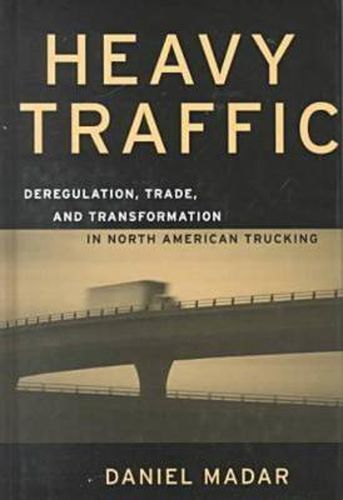
Canada and the United States exchange the world’s highest level of bilateral trade, valued at $1.4 billion a day. Two-thirds of this trade travels on trucks. Heavy Traffic examines the way in which the regulatory reform of American and Canadian trucking, coupled with free trade, has internationalized this vital industry.
Before deregulation, restrictive entry rules had fostered two separate national highway transportation markets, and most international traffic had to be exchanged at the border. When the United States deregulated first, the imbalance between its opened market and Canada’s still-restricted one produced a surprisingly difficult bilateral dispute. American deregulation was motivated by domestic incentives, but the subsequent Canadian deregulation blended domestic incentives with transborder rate comparisons and concerns about trade competitiveness.
Daniel Madar shows that deregulation created a de facto regime of free trade in trucking services. Removing regulatory barriers has enabled Canadian and American carriers to follow the expansion of transborder traffic that began with the Canada-US Free Trade Agreement and continues with NAFTA. The services available with deregulated trucking have also supported sweeping changes in industrial logistics. As transborder traffic has surged, the two countries’ carriers - from billion-dollar corporations to family firms - have exploited the latitude provided by deregulation.
This book is a valuable contribution to our understanding of the policy processes and economic conditions that led to trucking deregulation. As a study in public policy formation and the international effects of reform, it will be of interest to students and scholars of political economy, international relations, and transportation.
$9.00 standard shipping within Australia
FREE standard shipping within Australia for orders over $100.00
Express & International shipping calculated at checkout
Stock availability can be subject to change without notice. We recommend calling the shop or contacting our online team to check availability of low stock items. Please see our Shopping Online page for more details.
Canada and the United States exchange the world’s highest level of bilateral trade, valued at $1.4 billion a day. Two-thirds of this trade travels on trucks. Heavy Traffic examines the way in which the regulatory reform of American and Canadian trucking, coupled with free trade, has internationalized this vital industry.
Before deregulation, restrictive entry rules had fostered two separate national highway transportation markets, and most international traffic had to be exchanged at the border. When the United States deregulated first, the imbalance between its opened market and Canada’s still-restricted one produced a surprisingly difficult bilateral dispute. American deregulation was motivated by domestic incentives, but the subsequent Canadian deregulation blended domestic incentives with transborder rate comparisons and concerns about trade competitiveness.
Daniel Madar shows that deregulation created a de facto regime of free trade in trucking services. Removing regulatory barriers has enabled Canadian and American carriers to follow the expansion of transborder traffic that began with the Canada-US Free Trade Agreement and continues with NAFTA. The services available with deregulated trucking have also supported sweeping changes in industrial logistics. As transborder traffic has surged, the two countries’ carriers - from billion-dollar corporations to family firms - have exploited the latitude provided by deregulation.
This book is a valuable contribution to our understanding of the policy processes and economic conditions that led to trucking deregulation. As a study in public policy formation and the international effects of reform, it will be of interest to students and scholars of political economy, international relations, and transportation.
Search our extensive online catalogue.
