Readings Newsletter
Become a Readings Member to make your shopping experience even easier.
Sign in or sign up for free!
You’re not far away from qualifying for FREE standard shipping within Australia
You’ve qualified for FREE standard shipping within Australia
The cart is loading…


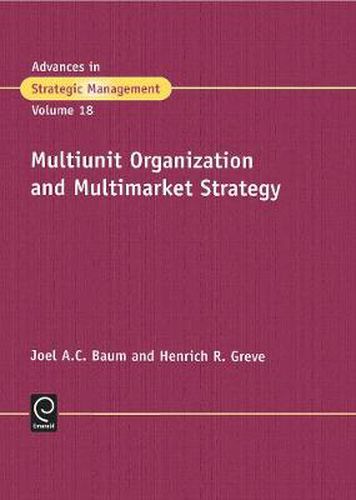
A conspicuous feature of the modern economy is the multitude of multiunit systems that operate in several markets - an organizational form that arguably rivals the M-form as the 20th century’s most successful. Research traditions studying multiunit systems include the multimarket perspective, which has used commitment and mutual forbearance theory, and the multiunit perspective, which has used learning and knowledge transfer theory. These perspectives are interdisciplinary, but to date there has been little direct interaction among them. This text aims to bring these areas together, discussing such things as: examining how variation in firm capabilities affects the co-ordination of branches and thus their forbearance or transfer of routines; bridging theories of market conduct and internal behaviour to explore how knowledge about markets and competitor behaviour is transferred among organizational units; making a theory of contingent multiunit or single-unit competitive advantage that can account for the coexistence of these organizational forms in many markets; and examining the effects of firm contacts in alliances or technological fields on their competitive behaviours.
$9.00 standard shipping within Australia
FREE standard shipping within Australia for orders over $100.00
Express & International shipping calculated at checkout
Stock availability can be subject to change without notice. We recommend calling the shop or contacting our online team to check availability of low stock items. Please see our Shopping Online page for more details.
A conspicuous feature of the modern economy is the multitude of multiunit systems that operate in several markets - an organizational form that arguably rivals the M-form as the 20th century’s most successful. Research traditions studying multiunit systems include the multimarket perspective, which has used commitment and mutual forbearance theory, and the multiunit perspective, which has used learning and knowledge transfer theory. These perspectives are interdisciplinary, but to date there has been little direct interaction among them. This text aims to bring these areas together, discussing such things as: examining how variation in firm capabilities affects the co-ordination of branches and thus their forbearance or transfer of routines; bridging theories of market conduct and internal behaviour to explore how knowledge about markets and competitor behaviour is transferred among organizational units; making a theory of contingent multiunit or single-unit competitive advantage that can account for the coexistence of these organizational forms in many markets; and examining the effects of firm contacts in alliances or technological fields on their competitive behaviours.
Search our extensive online catalogue.
