Readings Newsletter
Become a Readings Member to make your shopping experience even easier.
Sign in or sign up for free!
You’re not far away from qualifying for FREE standard shipping within Australia
You’ve qualified for FREE standard shipping within Australia
The cart is loading…


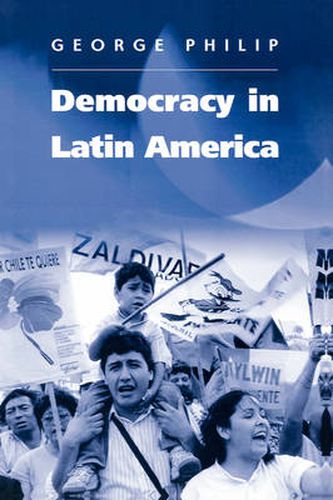
Latin America has seen a great extension of democratic government over the past twenty years. However democratisation has proved problematic in a number of ways: many Latin American countries have seen little per capita growth; poverty has increased; and political crises have often recurred. The idea of the a Washington consensusa – that democracy, free markets and prosperity would go together in the region – has so far failed. In the first part of the book, George Philip identifies the reasons why this should be so. The chapters are organised around relevant historical and institutional factors, such as problems with law enforcement and political tensions inherent in some Latin American variants of presidentialism, authoritarian legacies and patrimonial bureaucracies, civil–military relations, market reform and international intervention. Globalization has exacerbated these difficulties, since it has aggravated the already acute problems of governance facing emerging democracies. The second part of the book explores these issues in relation to a series of case studies involving Peru, Mexico and Venezuela. This will be an ideal textbook for students taking courses in Latin American politics and Latin American Studies.
$9.00 standard shipping within Australia
FREE standard shipping within Australia for orders over $100.00
Express & International shipping calculated at checkout
Stock availability can be subject to change without notice. We recommend calling the shop or contacting our online team to check availability of low stock items. Please see our Shopping Online page for more details.
Latin America has seen a great extension of democratic government over the past twenty years. However democratisation has proved problematic in a number of ways: many Latin American countries have seen little per capita growth; poverty has increased; and political crises have often recurred. The idea of the a Washington consensusa – that democracy, free markets and prosperity would go together in the region – has so far failed. In the first part of the book, George Philip identifies the reasons why this should be so. The chapters are organised around relevant historical and institutional factors, such as problems with law enforcement and political tensions inherent in some Latin American variants of presidentialism, authoritarian legacies and patrimonial bureaucracies, civil–military relations, market reform and international intervention. Globalization has exacerbated these difficulties, since it has aggravated the already acute problems of governance facing emerging democracies. The second part of the book explores these issues in relation to a series of case studies involving Peru, Mexico and Venezuela. This will be an ideal textbook for students taking courses in Latin American politics and Latin American Studies.
Search our extensive online catalogue.
