Readings Newsletter
Become a Readings Member to make your shopping experience even easier.
Sign in or sign up for free!
You’re not far away from qualifying for FREE standard shipping within Australia
You’ve qualified for FREE standard shipping within Australia
The cart is loading…


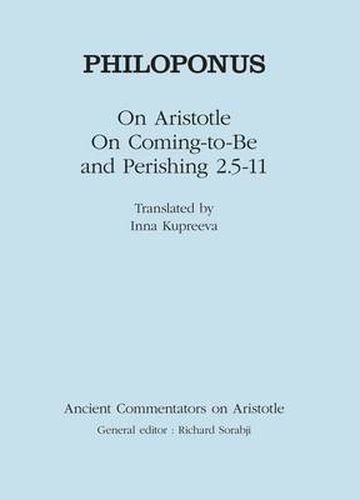
Until the launch of this series over ten years ago, the 15,000 volumes of the ancient Greek commentators on Aristotle, written mainly between 200 and 600 AD, constituted the largest corpus of extant Greek philosophical writings not translated into English or other European languages. Over 30 volumes have now appeared in the series, which is planned in some 60 volumes altogether. Subjects covered in this, the third and last, volume of translation of this work include: why the elements are four in number; what’s wrong with Empedocles’ theory of elements; how homogeneous stuffs, particularly the tissues of a living body, come to be and consist of the elements. The volume also contains very important discussions of causes, particularly of efficient cause, and of necessity in the sphere of generation and corruption. It will be of interest to the students of ancient philosophy and science (the commentary draws on earlier philosophical and medical texts); of Patristics and Christian Theology (it allows comparison of Philoponus’ later creationist doctrine with his earlier ideas about generation); of medieval philosophy (this text was known to the Arabs; it is used by Avicenna and Averroes); and to anyone with interest in the metaphysics of causation, emergence, necessity and determinism.
$9.00 standard shipping within Australia
FREE standard shipping within Australia for orders over $100.00
Express & International shipping calculated at checkout
Stock availability can be subject to change without notice. We recommend calling the shop or contacting our online team to check availability of low stock items. Please see our Shopping Online page for more details.
Until the launch of this series over ten years ago, the 15,000 volumes of the ancient Greek commentators on Aristotle, written mainly between 200 and 600 AD, constituted the largest corpus of extant Greek philosophical writings not translated into English or other European languages. Over 30 volumes have now appeared in the series, which is planned in some 60 volumes altogether. Subjects covered in this, the third and last, volume of translation of this work include: why the elements are four in number; what’s wrong with Empedocles’ theory of elements; how homogeneous stuffs, particularly the tissues of a living body, come to be and consist of the elements. The volume also contains very important discussions of causes, particularly of efficient cause, and of necessity in the sphere of generation and corruption. It will be of interest to the students of ancient philosophy and science (the commentary draws on earlier philosophical and medical texts); of Patristics and Christian Theology (it allows comparison of Philoponus’ later creationist doctrine with his earlier ideas about generation); of medieval philosophy (this text was known to the Arabs; it is used by Avicenna and Averroes); and to anyone with interest in the metaphysics of causation, emergence, necessity and determinism.
Search our extensive online catalogue.
