Readings Newsletter
Become a Readings Member to make your shopping experience even easier.
Sign in or sign up for free!
You’re not far away from qualifying for FREE standard shipping within Australia
You’ve qualified for FREE standard shipping within Australia
The cart is loading…


An examination of the symbiotic and productive relationship between fully nonlinear partial differential equations and generalized potential theories
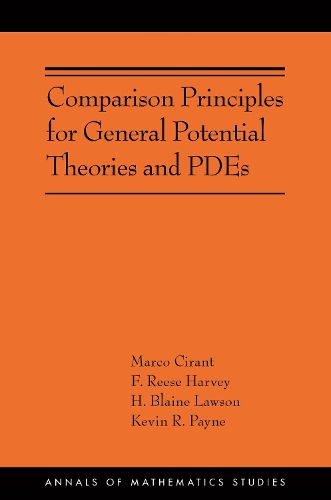
In recent years, there has evolved a symbiotic and productive relationship between fully nonlinear partial differential equations and generalized potential theories. This book examines important aspects of this story. One main purpose is to prove comparison principles for nonlinear potential theories in Euclidian spaces straightforwardly from duality and monotonicity under the weakest possible notion of ellipticity. The book also shows how to deduce comparison principles for nonlinear differential operators, by marrying these two points of view, under the correspondence principle.
The authors explain that comparison principles are fundamental in both contexts, since they imply uniqueness for the Dirichlet problem. When combined with appropriate boundary geometries, yielding suitable barrier functions, they also give existence by Perron's method. There are many opportunities for cross-fertilization and synergy. In potential theory, one is given a constraint set of 2-jets that determines its subharmonic functions. The constraint set also determines a family of compatible differential operators. Because there are many such operators, potential theory strengthens and simplifies the operator theory. Conversely, the set of operators associated with the constraint can influence the potential theory.
$9.00 standard shipping within Australia
FREE standard shipping within Australia for orders over $100.00
Express & International shipping calculated at checkout
Stock availability can be subject to change without notice. We recommend calling the shop or contacting our online team to check availability of low stock items. Please see our Shopping Online page for more details.
An examination of the symbiotic and productive relationship between fully nonlinear partial differential equations and generalized potential theories
In recent years, there has evolved a symbiotic and productive relationship between fully nonlinear partial differential equations and generalized potential theories. This book examines important aspects of this story. One main purpose is to prove comparison principles for nonlinear potential theories in Euclidian spaces straightforwardly from duality and monotonicity under the weakest possible notion of ellipticity. The book also shows how to deduce comparison principles for nonlinear differential operators, by marrying these two points of view, under the correspondence principle.
The authors explain that comparison principles are fundamental in both contexts, since they imply uniqueness for the Dirichlet problem. When combined with appropriate boundary geometries, yielding suitable barrier functions, they also give existence by Perron's method. There are many opportunities for cross-fertilization and synergy. In potential theory, one is given a constraint set of 2-jets that determines its subharmonic functions. The constraint set also determines a family of compatible differential operators. Because there are many such operators, potential theory strengthens and simplifies the operator theory. Conversely, the set of operators associated with the constraint can influence the potential theory.
Search our extensive online catalogue.
