Readings Newsletter
Become a Readings Member to make your shopping experience even easier.
Sign in or sign up for free!
You’re not far away from qualifying for FREE standard shipping within Australia
You’ve qualified for FREE standard shipping within Australia
The cart is loading…


This title is printed to order. This book may have been self-published. If so, we cannot guarantee the quality of the content. In the main most books will have gone through the editing process however some may not. We therefore suggest that you be aware of this before ordering this book. If in doubt check either the author or publisher’s details as we are unable to accept any returns unless they are faulty. Please contact us if you have any questions.
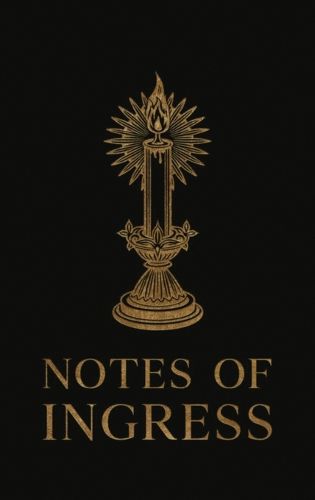
(This edition does not include the original artwork.) Notes of Ingress is a mesmerizing and deeply mysterious work that eludes ordinary classification. Is it a book? Not in the traditional sense. A living threshold is what it is; a collaboration between the living and the dead, scribed by Cain Helsson through the voices of spirit-possessed mediums. Its structure is deliberately disorienting, weaving together overlapping voices, contradictions, and harmonies. Indeed, if one were to describe it periphrastically, it could be said to mirror-both in its nature and in the reader's experience of it-the chaotic and multifaceted world of spirit contact.
The foreword of the book, written by Arthur Veil, sets the tone with a warning: this is not a work for the curious or casual reader. It is meant for initiates-those who already stand within or just beyond the "circle of initiatory fire." The prose is rich and archaic, and I imagine it would work even better as a read-aloud. Its rhythms echo the ancient cadences of grimoires or esoteric manuscripts. The content is spiritual and a bit surreal, with a narrative that bounces around to the various parts of the personality, like a film that jump cuts between parallel storylines.
One of the most striking aspects of Notes of Ingress is its authenticity. The voices of the spirits-whether they are the dead, the never-born, or figures like Lucifer-feel palpable and immediate. The book's visual elements, crafted under the guidance of Lucifer himself by illustrators like Fares Kaze, are not mere decorations but transmissions in their own right, adding another dimension to the work. The interplay between text and imagery creates a holistic experience that transcends the written word.
The book thematically investigates the transitional spaces that exist between life and death, between what is seen and what is unseen. The practices it describes-like shape-leaping, night-sitting, and spirit possession-are rooted in ancient traditions yet feel fully relevant today. Of note is a section detailing the Benandanti, a secret society of spirit-warriors who do battle with witches in dreamlike realms. Its description of the Benandanti's rituals and initiations and of the Lombard's gift of witch-fire is so vivid that it renders the realm of the mythical undifferentiated from that of the real.
Still, Notes of Ingress poses challenges to readers. With its non-linear narrative and multiple intersecting voices, the text can feel a bit like a maze. And let's face it: the old-timey language isn't going to appeal to everyone. But these features are very much the book's design. Like any good ghost story, Ingress wants to unsettle, to make you confront the dark and the unknown.
To sum up, Notes of Ingress is a profound and disturbing esoteric work of literature. It is a mirror, a blade, a maze, and a key-all at once. For those who are ready to traverse its shadowy pages, it offers not only understanding but also transformation. Cain Helsson and the spirits who guided this work have crafted something truly unique: a book that is not only read but also lived through, a doorway to places beyond the veil.
$9.00 standard shipping within Australia
FREE standard shipping within Australia for orders over $100.00
Express & International shipping calculated at checkout
Stock availability can be subject to change without notice. We recommend calling the shop or contacting our online team to check availability of low stock items. Please see our Shopping Online page for more details.
This title is printed to order. This book may have been self-published. If so, we cannot guarantee the quality of the content. In the main most books will have gone through the editing process however some may not. We therefore suggest that you be aware of this before ordering this book. If in doubt check either the author or publisher’s details as we are unable to accept any returns unless they are faulty. Please contact us if you have any questions.
(This edition does not include the original artwork.) Notes of Ingress is a mesmerizing and deeply mysterious work that eludes ordinary classification. Is it a book? Not in the traditional sense. A living threshold is what it is; a collaboration between the living and the dead, scribed by Cain Helsson through the voices of spirit-possessed mediums. Its structure is deliberately disorienting, weaving together overlapping voices, contradictions, and harmonies. Indeed, if one were to describe it periphrastically, it could be said to mirror-both in its nature and in the reader's experience of it-the chaotic and multifaceted world of spirit contact.
The foreword of the book, written by Arthur Veil, sets the tone with a warning: this is not a work for the curious or casual reader. It is meant for initiates-those who already stand within or just beyond the "circle of initiatory fire." The prose is rich and archaic, and I imagine it would work even better as a read-aloud. Its rhythms echo the ancient cadences of grimoires or esoteric manuscripts. The content is spiritual and a bit surreal, with a narrative that bounces around to the various parts of the personality, like a film that jump cuts between parallel storylines.
One of the most striking aspects of Notes of Ingress is its authenticity. The voices of the spirits-whether they are the dead, the never-born, or figures like Lucifer-feel palpable and immediate. The book's visual elements, crafted under the guidance of Lucifer himself by illustrators like Fares Kaze, are not mere decorations but transmissions in their own right, adding another dimension to the work. The interplay between text and imagery creates a holistic experience that transcends the written word.
The book thematically investigates the transitional spaces that exist between life and death, between what is seen and what is unseen. The practices it describes-like shape-leaping, night-sitting, and spirit possession-are rooted in ancient traditions yet feel fully relevant today. Of note is a section detailing the Benandanti, a secret society of spirit-warriors who do battle with witches in dreamlike realms. Its description of the Benandanti's rituals and initiations and of the Lombard's gift of witch-fire is so vivid that it renders the realm of the mythical undifferentiated from that of the real.
Still, Notes of Ingress poses challenges to readers. With its non-linear narrative and multiple intersecting voices, the text can feel a bit like a maze. And let's face it: the old-timey language isn't going to appeal to everyone. But these features are very much the book's design. Like any good ghost story, Ingress wants to unsettle, to make you confront the dark and the unknown.
To sum up, Notes of Ingress is a profound and disturbing esoteric work of literature. It is a mirror, a blade, a maze, and a key-all at once. For those who are ready to traverse its shadowy pages, it offers not only understanding but also transformation. Cain Helsson and the spirits who guided this work have crafted something truly unique: a book that is not only read but also lived through, a doorway to places beyond the veil.
Search our extensive online catalogue.
