Readings Newsletter
Become a Readings Member to make your shopping experience even easier.
Sign in or sign up for free!
You’re not far away from qualifying for FREE standard shipping within Australia
You’ve qualified for FREE standard shipping within Australia
The cart is loading…


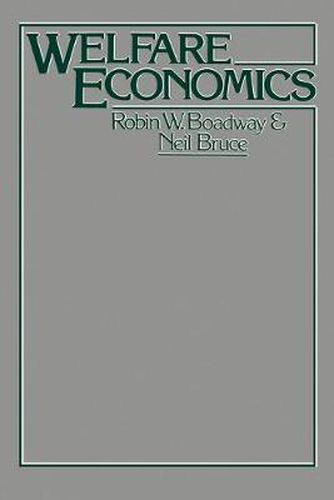
This clear and balanced introduction to welfare economics reflects the most recent advances in the field. Designed for third–year undergraduate and graduate courses, it offers an extensive treatment of both the theory of welfare economics and the techniques for applying that theory to real problems. The first part of the book presents a synthesis of the theory. Starting from the premise that the purpose of theory is to provide criteria for ordering alternative economic states, the authors analyse the relationship between individual and social orderings. They discuss the conditions of Pareto efficiency and optimality as well as the ways in which market economies may fail to achieve a Pareto optimal allocation of resources. They go on to evaluate the theory of social welfare functions, paying particular attention to recent developments. The second part of the book considers the principles of applied welfare economics. Developing the use of the compensating variation as their main tool, the authors discuss welfare change measurement in single–person and many–person economies. In the final chapter they survey the recent literature on cost–benefit analysis.
$9.00 standard shipping within Australia
FREE standard shipping within Australia for orders over $100.00
Express & International shipping calculated at checkout
Stock availability can be subject to change without notice. We recommend calling the shop or contacting our online team to check availability of low stock items. Please see our Shopping Online page for more details.
This clear and balanced introduction to welfare economics reflects the most recent advances in the field. Designed for third–year undergraduate and graduate courses, it offers an extensive treatment of both the theory of welfare economics and the techniques for applying that theory to real problems. The first part of the book presents a synthesis of the theory. Starting from the premise that the purpose of theory is to provide criteria for ordering alternative economic states, the authors analyse the relationship between individual and social orderings. They discuss the conditions of Pareto efficiency and optimality as well as the ways in which market economies may fail to achieve a Pareto optimal allocation of resources. They go on to evaluate the theory of social welfare functions, paying particular attention to recent developments. The second part of the book considers the principles of applied welfare economics. Developing the use of the compensating variation as their main tool, the authors discuss welfare change measurement in single–person and many–person economies. In the final chapter they survey the recent literature on cost–benefit analysis.
Search our extensive online catalogue.
