Readings Newsletter
Become a Readings Member to make your shopping experience even easier.
Sign in or sign up for free!
You’re not far away from qualifying for FREE standard shipping within Australia
You’ve qualified for FREE standard shipping within Australia
The cart is loading…


This title is printed to order. This book may have been self-published. If so, we cannot guarantee the quality of the content. In the main most books will have gone through the editing process however some may not. We therefore suggest that you be aware of this before ordering this book. If in doubt check either the author or publisher’s details as we are unable to accept any returns unless they are faulty. Please contact us if you have any questions.
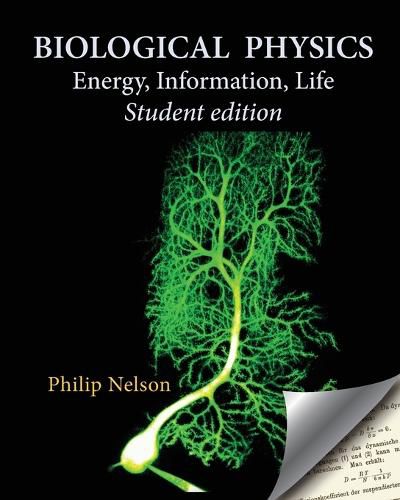
Award-winning professor brings you from first-year physics and chemistry to the frontier of single-molecule biophysics. Biological Physics is a university textbook that focuses on results in molecular motors, self-assembly, and single-molecule manipulation that have revolutionized the field in recent years, and integrates these topics with classic results in statistical physics, biophysical chemistry, and neuroscience. The text also provides foundational material for the emerging fields of nanotechnology and mechanobiology, and has significant overlap with the revised MCAT exam. This inexpensive new edition updates the classic book, particularly the chapter on motors, and incorporates many clarifications and enhancements throughout. Exercises are given at all levels of difficulty. Instead of offering a huge pile of facts, the discovery-style exposition frequently asks the reader to reflect on How could anything like that happen at all? and then shows how science, and scientists, have proceeded incrementally to peel back the layers of mystery surrounding these beautiful mechanisms. Working through this book will give you an appreciation for how science has advanced in the past, and the skills and frameworks needed to push forward in the future.
Additional topics include the statistical physics of diffusion; bacterial motility; self-assembly; entropic forces; enzyme kinetics; ion channels and pumps; the chemiosmotic mechanism and its role in ATP maintenance; and the discovery of the mechanism of neural signaling.
$9.00 standard shipping within Australia
FREE standard shipping within Australia for orders over $100.00
Express & International shipping calculated at checkout
Stock availability can be subject to change without notice. We recommend calling the shop or contacting our online team to check availability of low stock items. Please see our Shopping Online page for more details.
This title is printed to order. This book may have been self-published. If so, we cannot guarantee the quality of the content. In the main most books will have gone through the editing process however some may not. We therefore suggest that you be aware of this before ordering this book. If in doubt check either the author or publisher’s details as we are unable to accept any returns unless they are faulty. Please contact us if you have any questions.
Award-winning professor brings you from first-year physics and chemistry to the frontier of single-molecule biophysics. Biological Physics is a university textbook that focuses on results in molecular motors, self-assembly, and single-molecule manipulation that have revolutionized the field in recent years, and integrates these topics with classic results in statistical physics, biophysical chemistry, and neuroscience. The text also provides foundational material for the emerging fields of nanotechnology and mechanobiology, and has significant overlap with the revised MCAT exam. This inexpensive new edition updates the classic book, particularly the chapter on motors, and incorporates many clarifications and enhancements throughout. Exercises are given at all levels of difficulty. Instead of offering a huge pile of facts, the discovery-style exposition frequently asks the reader to reflect on How could anything like that happen at all? and then shows how science, and scientists, have proceeded incrementally to peel back the layers of mystery surrounding these beautiful mechanisms. Working through this book will give you an appreciation for how science has advanced in the past, and the skills and frameworks needed to push forward in the future.
Additional topics include the statistical physics of diffusion; bacterial motility; self-assembly; entropic forces; enzyme kinetics; ion channels and pumps; the chemiosmotic mechanism and its role in ATP maintenance; and the discovery of the mechanism of neural signaling.
Search our extensive online catalogue.
