Readings Newsletter
Become a Readings Member to make your shopping experience even easier.
Sign in or sign up for free!
You’re not far away from qualifying for FREE standard shipping within Australia
You’ve qualified for FREE standard shipping within Australia
The cart is loading…


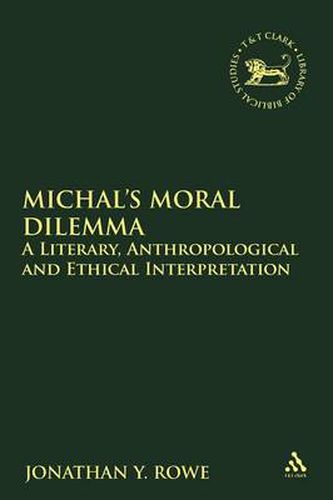
Michal’s Moral Dilemma proposes that attention should be paid to the moral goods that feature in the text, before arguing that the family, a central feature of Old Testament morality, should be understood as a set of practices rather than an institution. Jonathan Rowe discusses the use of models of social action to comprehend the social world of the Bible, and suggests a modified version of Bakhtin’s theory of heteroglossic voices can help readers appreciate how authors present a moral vision by approving some characters’ actions whilst undermining others.
The discussion of Michal’s moral dilemma adduces anthropological theories and ethnographic data concerning violence, lying, and the relationship between fathers and daughters. Given that the conflicts of moral goods are resolved by characters choosing to act in a certain way, Rowe enquires after the author’s assessment of each character’s moral choices, arguing that Michal’s loyalty to David and deception of Saul was counter-cultural. By approving of her choice the author affirms the importance of loyalty to the Davidic dynasty.
$9.00 standard shipping within Australia
FREE standard shipping within Australia for orders over $100.00
Express & International shipping calculated at checkout
Stock availability can be subject to change without notice. We recommend calling the shop or contacting our online team to check availability of low stock items. Please see our Shopping Online page for more details.
Michal’s Moral Dilemma proposes that attention should be paid to the moral goods that feature in the text, before arguing that the family, a central feature of Old Testament morality, should be understood as a set of practices rather than an institution. Jonathan Rowe discusses the use of models of social action to comprehend the social world of the Bible, and suggests a modified version of Bakhtin’s theory of heteroglossic voices can help readers appreciate how authors present a moral vision by approving some characters’ actions whilst undermining others.
The discussion of Michal’s moral dilemma adduces anthropological theories and ethnographic data concerning violence, lying, and the relationship between fathers and daughters. Given that the conflicts of moral goods are resolved by characters choosing to act in a certain way, Rowe enquires after the author’s assessment of each character’s moral choices, arguing that Michal’s loyalty to David and deception of Saul was counter-cultural. By approving of her choice the author affirms the importance of loyalty to the Davidic dynasty.
Search our extensive online catalogue.
