Readings Newsletter
Become a Readings Member to make your shopping experience even easier.
Sign in or sign up for free!
You’re not far away from qualifying for FREE standard shipping within Australia
You’ve qualified for FREE standard shipping within Australia
The cart is loading…


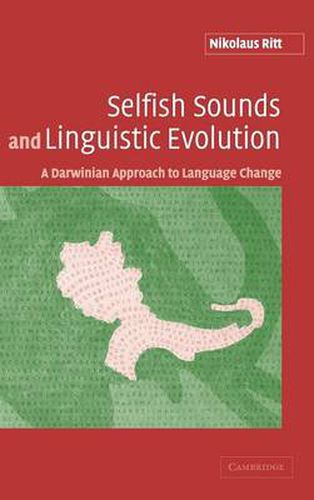
This book takes an exciting new perspective on language change, by explaining it in terms of Darwin’s evolutionary theory. Looking at a number of developments in the history of sounds and words, Nikolaus Ritt shows how the constituents of language can be regarded as mental patterns, or ‘memes’, which copy themselves from one brain to another when communication and language acquisition take place. Memes are both stable in that they transmit faithfully from brain to brain, and active in that their success at replicating depends upon their own properties. Ritt uses this controversial approach to challenge established models of linguistic competence, in which speakers acquire, use, and shape language. In Darwinian terms, language evolution is something that happens to, rather than through, speakers, and the interests of linguistic constituents matter more than those of their human ‘hosts’. This book will stimulate debate among evolutionary biologists, cognitive scientists and linguists alike.
$9.00 standard shipping within Australia
FREE standard shipping within Australia for orders over $100.00
Express & International shipping calculated at checkout
Stock availability can be subject to change without notice. We recommend calling the shop or contacting our online team to check availability of low stock items. Please see our Shopping Online page for more details.
This book takes an exciting new perspective on language change, by explaining it in terms of Darwin’s evolutionary theory. Looking at a number of developments in the history of sounds and words, Nikolaus Ritt shows how the constituents of language can be regarded as mental patterns, or ‘memes’, which copy themselves from one brain to another when communication and language acquisition take place. Memes are both stable in that they transmit faithfully from brain to brain, and active in that their success at replicating depends upon their own properties. Ritt uses this controversial approach to challenge established models of linguistic competence, in which speakers acquire, use, and shape language. In Darwinian terms, language evolution is something that happens to, rather than through, speakers, and the interests of linguistic constituents matter more than those of their human ‘hosts’. This book will stimulate debate among evolutionary biologists, cognitive scientists and linguists alike.
Search our extensive online catalogue.
