Readings Newsletter
Become a Readings Member to make your shopping experience even easier.
Sign in or sign up for free!
You’re not far away from qualifying for FREE standard shipping within Australia
You’ve qualified for FREE standard shipping within Australia
The cart is loading…


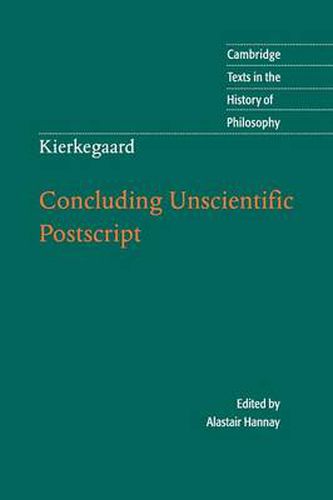
Kierkegaard’s Concluding Unscientific Postscript is a classic of existential literature. It concludes the first and richest phase of Kierkegaard’s pseudonymous authorship and is the text that philosophers look to first when attempting to define Kierkegaard’s own philosophy. Familiar Kierkegaardian themes are introduced in the work, including truth as subjectivity, indirect communication, the leap, and the impossibility of forming a philosophical system for human existence. The Postscript sums up the aims of the preceding pseudonymous works and opens the way to the next part of Kierkegaard’s increasingly tempestuous life: it can thus be seen as a cornerstone of his philosophical thought. This volume offers the work in a new and accessible translation by Alastair Hannay, together with an introduction that sets the work in its philosophical and historical contexts.
$9.00 standard shipping within Australia
FREE standard shipping within Australia for orders over $100.00
Express & International shipping calculated at checkout
Stock availability can be subject to change without notice. We recommend calling the shop or contacting our online team to check availability of low stock items. Please see our Shopping Online page for more details.
Kierkegaard’s Concluding Unscientific Postscript is a classic of existential literature. It concludes the first and richest phase of Kierkegaard’s pseudonymous authorship and is the text that philosophers look to first when attempting to define Kierkegaard’s own philosophy. Familiar Kierkegaardian themes are introduced in the work, including truth as subjectivity, indirect communication, the leap, and the impossibility of forming a philosophical system for human existence. The Postscript sums up the aims of the preceding pseudonymous works and opens the way to the next part of Kierkegaard’s increasingly tempestuous life: it can thus be seen as a cornerstone of his philosophical thought. This volume offers the work in a new and accessible translation by Alastair Hannay, together with an introduction that sets the work in its philosophical and historical contexts.
Search our extensive online catalogue.
